


NEWS
ESS Manufacturer | Battery Technology | Global Energy Partner
From MW to GW: Why Battery Energy Storage Systems Are Becoming Mandatory in Renewable Energy Projects
Lead — GW-Scale Battery Energy Storage Projects Accelerate Globally
The global energy storage market is entering a new phase of large-scale deployment, as GW-scale Battery Energy Storage System (BESS) projects are increasingly integrated into renewable energy infrastructure across multiple regions. These projects are no longer experimental assets, but are becoming standard components of utility-scale renewable developments.
Recent deployments across the Middle East, Europe, and North America show a clear pattern: 1GW wind power plants are now frequently paired with 500MWh to 1GWh-scale battery storage systems, forming integrated renewable energy storage systems designed to stabilize grid output and manage intermittency.
According to system transition analysis from the International Energy Agency, the rapid growth of renewable penetration is forcing power systems to adopt large-scale storage solutions to maintain grid reliability, frequency stability, and peak load management.

Why This Shift Is Happening
The core drivers behind this acceleration include:
- Increasing volatility from wind and solar generation
- Rising demand for real-time grid balancing services
- Expansion of renewable-heavy power markets in emerging and developed regions
Market Impact
As a result, battery energy storage systems (BESS) are transitioning from optional infrastructure to mandatory grid assets. This shift is redefining project development standards, where storage is no longer an add-on but a core requirement for renewable energy integration.
In practice, this means that large-scale renewable projects are now being designed with built-in storage capacity from the outset, fundamentally changing how energy systems are planned and financed globally.
Global Surge in GW-Scale Battery Energy Storage System Deployments
The deployment of battery energy storage system (BESS) projects at gigawatt scale is accelerating globally, marking a clear transition from pilot demonstrations to standardized commercial infrastructure. Across major renewable energy markets, utility-scale developers are increasingly integrating storage directly into wind and solar projects rather than treating it as an optional add-on.
In particular, 1GW wind + BESS hybrid projects are becoming a recurring design pattern in new energy developments. These systems typically pair large wind farms with 500MWh to 1GWh battery clusters, enabling smoother power output, improved grid stability, and better utilization of renewable generation assets.
According to global energy system transition analysis from the International Energy Agency, the rapid expansion of variable renewable energy is driving strong demand for flexible storage capacity, particularly in regions with high wind penetration and constrained grid infrastructure.

From Demonstration to Commercial Standard
Historically, BESS was deployed mainly as demonstration or pilot projects. However, recent project pipelines in Europe, North America, and the Middle East show a structural shift toward full commercial deployment:
- Wind + storage co-location is now a standard engineering approach
- Storage sizing is increasingly optimized at grid level rather than project level
- Multi-hundred MWh systems are becoming baseline rather than exceptional
Industry Implication
This evolution confirms that the BESS system is no longer an emerging technology but a core component of modern power infrastructure. It is now being embedded into project design from the earliest planning stages.
Regional Breakdown — Middle East, Europe, North America
The acceleration of renewable energy integration is not uniform across global markets. Instead, it is being driven by region-specific grid structures, resource endowments, and policy frameworks, all of which are shaping the deployment of renewable energy storage systems at GW scale.
1️⃣ Middle East
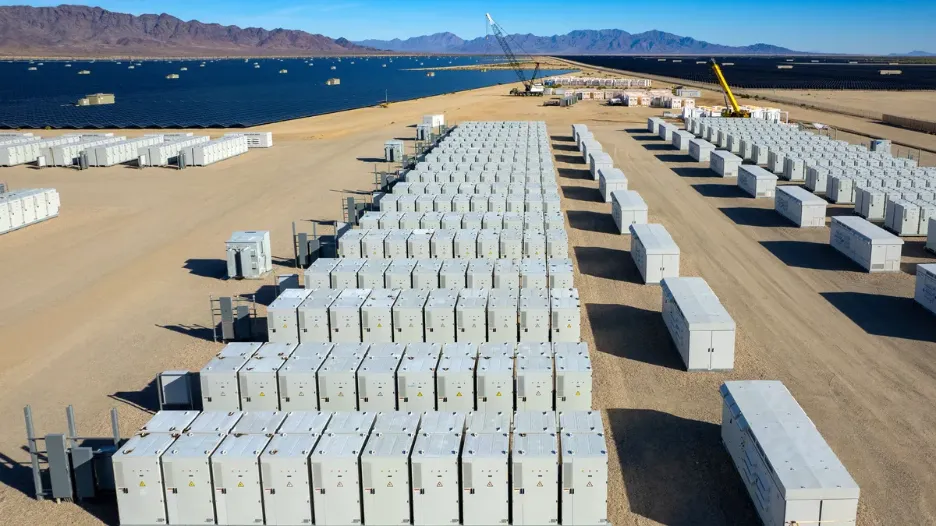
In the Middle East, large-scale desert solar projects are increasingly paired with battery storage to address extreme diurnal variation between daytime generation and evening peak demand. These solar + storage hybrid systems are primarily designed for peak shifting and grid stability, where high ambient temperatures also place additional demands on system thermal management and reliability.
2️⃣ Europe
Europe’s energy transition is heavily influenced by high penetration of wind power and interconnected but increasingly congested transmission networks. This results in frequent grid volatility, particularly in Northern and Western Europe. As a result, battery storage is being deployed to provide frequency regulation, congestion relief, and renewable smoothing services, making grid-scale BESS systems a critical infrastructure component.
3️⃣ North America
In North America, market-driven electricity pricing and independent power systems have created strong economic incentives for energy arbitrage and capacity markets. This has accelerated investment in large-scale storage projects, particularly in regions with high solar penetration such as California and Texas.
Unified Industry Logic
Despite regional differences, the underlying trend is consistent: renewable energy integration is accelerating globally, and battery storage is becoming the enabling infrastructure that stabilizes increasingly decentralized power systems.

Why GW-Scale Projects Are Becoming the New Standard
The rapid emergence of GW-scale battery energy storage system (BESS) projects is fundamentally driven by three structural changes in global power systems: increasing renewable volatility, rising grid stability requirements, and improving economics at scale.
Firstly, renewable volatility has become a defining challenge of modern electricity grids. Wind and solar generation are inherently intermittent, creating frequent mismatches between supply and demand. As penetration increases, system operators must rely on large-scale storage to absorb excess generation and release energy during shortages.
Secondly, grid stabilization requirements are intensifying. Services such as frequency regulation, voltage support, and ramp-rate control are now essential in grids with high renewable penetration. In markets like Texas and California, large-scale BESS assets are already actively used to stabilize grid frequency within milliseconds.
Thirdly, cost optimization at scale is accelerating adoption. As system sizes increase into the hundreds of megawatt-hours and gigawatt-hours, the solar battery storage cost per kWh declines due to economies of scale in procurement, installation, and balance-of-system design. This has been a key enabler for utility-scale project financing.
According to system transition analysis from the International Energy Agency, energy storage deployment is scaling in direct correlation with renewable expansion, confirming that storage is now a core component of modern energy infrastructure rather than an optional asset.
A practical example is the growing number of 1GW wind + storage hybrid projects, where storage is integrated at the planning stage rather than retrofitted, signaling a clear shift toward standardized GW-scale deployment models.
Technology Backbone — BESS + BMS Integration
At the core of every modern battery energy storage system (BESS) is the Battery Management System (BMS), which functions as the control intelligence of the entire energy storage architecture. While battery cells determine energy capacity, the BMS ensures that this energy is delivered safely, efficiently, and consistently across thousands of cycles.
According to system safety and grid integration guidelines from the U.S. Department of Energy, advanced BMS design is essential for maintaining operational stability in grid scale energy storage applications, where systems may operate continuously under high charge-discharge frequency and variable load conditions.
Core Role of BMS in Grid-Scale Storage
The BMS performs three critical functions:
- Safety management: Prevents over-voltage, over-current, and thermal runaway risks
- State monitoring: Tracks SOC (State of Charge) and SOH (State of Health) in real time
- Cell balancing: Ensures uniform performance across large battery clusters
BMS Impact in Large-Scale Systems
|
Function |
Role in BESS |
System Impact |
|
Safety Control |
Thermal & electrical protection |
Prevents system failure |
|
Balancing |
Equalizes cell voltage |
Extends lifecycle |
|
Monitoring |
Real-time diagnostics |
Improves reliability |
Why It Matters More in Grid-Scale Systems
In large grid scale energy storage installations, even minor cell inconsistencies can scale into significant system-level inefficiencies. A robust BMS minimizes these effects by maintaining uniform operating conditions across thousands of cells, ensuring stable output and predictable degradation behavior.
Key Insight
As BESS systems scale up, the BMS evolves from a protective layer into a system optimization engine, directly influencing efficiency, safety, and long-term asset performance.
Market Impact — Energy Storage Market Enters Infrastructure Phase
The global energy storage market is undergoing a structural transition from standalone energy equipment deployment to long-term infrastructure asset development. This shift reflects the increasing role of battery storage in ensuring grid reliability, renewable integration, and system-level flexibility.
Historically, battery storage was treated as a modular energy asset deployed for specific functions such as peak shaving or backup power. However, as deployment scales increase, particularly in grid scale battery storage, storage systems are now being financed, developed, and operated as core infrastructure—similar to transmission networks or generation assets.
According to system investment trends highlighted by the International Energy Agency, capital allocation in energy systems is increasingly shifting toward long-duration flexibility assets, with storage playing a central role in renewable-heavy grids.

Shift in Market Structure
|
Phase |
Market View |
Investment Logic |
|
Equipment Phase |
Battery as product |
CAPEX-driven procurement |
|
Infrastructure Phase |
Storage as asset |
Lifecycle revenue (LCOS, arbitrage, grid services) |
EPC + IPP Model Expansion
EPC (Engineering, Procurement, Construction): Focus on integrated system delivery
IPP (Independent Power Producer): Long-term revenue from energy arbitrage and grid services
This model is increasingly common in large-scale renewable projects where storage is co-developed with wind and solar assets.
Key Insight
The evolution of the energy storage market signals a fundamental reclassification: storage is no longer a supporting technology but a core infrastructure layer enabling renewable-dominated power systems.
Manufacturing & Supply Chain Implications
The rapid expansion of battery energy storage system (BESS) deployments is reshaping the global supply chain for both cell producers and system integrators. As demand for grid scale battery storage accelerates, the role of lithium battery manufacturers is shifting from commodity suppliers to strategic infrastructure enablers.
At the same time, the BESS manufacturer landscape is becoming increasingly concentrated. Large-scale projects require high consistency, long lifecycle performance, and bankable supply chains—factors that naturally favor vertically integrated and technologically advanced players.
According to energy transition supply chain analysis from the International Energy Agency, scaling renewable energy systems is leading to tighter integration between upstream battery cell production and downstream system integration, increasing the importance of supply chain security and standardization.
Supply Chain Shift Overview
|
Segment |
Trend |
Market Impact |
|
Lithium Battery Manufacturer |
High demand growth |
Capacity expansion & consolidation |
|
BESS Manufacturer |
Increasing concentration |
Fewer but larger integrators |
|
Cell Supply Chain |
Vertical integration |
Improved cost control & reliability |
Industry Dynamics
- Leading cell producers such as CATL are strengthening their dominance in high-performance LFP and large-format cell segments
- System integrators are increasingly dependent on certified, high-consistency cell suppliers
- Project developers prioritize bankable supply chains to reduce financial risk in GW-scale projects
Key Insight
The supply chain is moving toward fewer but more capable manufacturers, where scale, consistency, and integration capability determine competitiveness in the rapidly growing energy storage ecosystem.
Strategic Insight — Storage Becomes Mandatory in Renewable Projects
Battery storage is no longer an optional add-on in renewable energy development—it is becoming a baseline requirement. In modern grid scale battery storage planning, wind and solar projects are increasingly designed with integrated storage to ensure dispatchability and grid compliance.
Utility-scale developers now treat storage as essential infrastructure for renewable integration, particularly in high-penetration markets. According to system transition assessments by the International Energy Agency, the variability of renewables is driving a structural need for flexible capacity, making storage deployment a core requirement rather than an enhancement.
In practice, many new 1GW wind + solar projects now include co-located storage systems as standard engineering configuration, effectively establishing a new industry baseline for project design and financing.
Conclusion — GW-Scale Storage Defines the New Energy Infrastructure Era
GW-scale battery deployment is now a defining global trend in power system development, driven by rapid renewable expansion and grid stability requirements. Across multiple regions, energy storage systems are no longer treated as supplementary assets but as core infrastructure components integrated into generation and transmission planning.

According to system transition analysis from the International Energy Agency, energy storage is moving from early-stage market expansion into a structurally embedded phase within modern electricity systems. This reflects a shift from volume-driven growth to infrastructure-level deployment.
As a result, the global energy storage market is entering a phase of structural expansion, where GW-scale projects such as 1GW wind-plus-storage hybrids are becoming the new standard rather than exceptions.
Ford Officially Launches Ford Energy: A Major Entry Into the Energy Storage Business Targeting Data Centers, Utilities, and C&I Markets
Is the Energy Storage Price War Finally Over as Battery Prices Rise and Margins Recover?
Related Article



contact us
For more questions please


Office Address: 701, Building A, Yonghuayuan Business Building, Baotian 2nd Road, Chentian Community, Xixiang Street, Bao'an District, Shenzhen, Guangdong Province, China
Factory Address 1: Room 701, Building 2, Kegu Industrial Park, Zone B, Jian'an Road, No. 790, Chang'an Town, Dongguan City, Guangdong Province, China
Factory Address 2: Building 7, Phase II Standardized Factory, Innovation Industrial Park, Duji Economic Development Zone, Huaibei City, Anhui Province, China