


NEWS
ESS Manufacturer | Battery Technology | Global Energy Partner
C&I Energy Storage Market 2026: Is It Dominating the Global Energy Storage Market?
LEAD PARAGRAPH
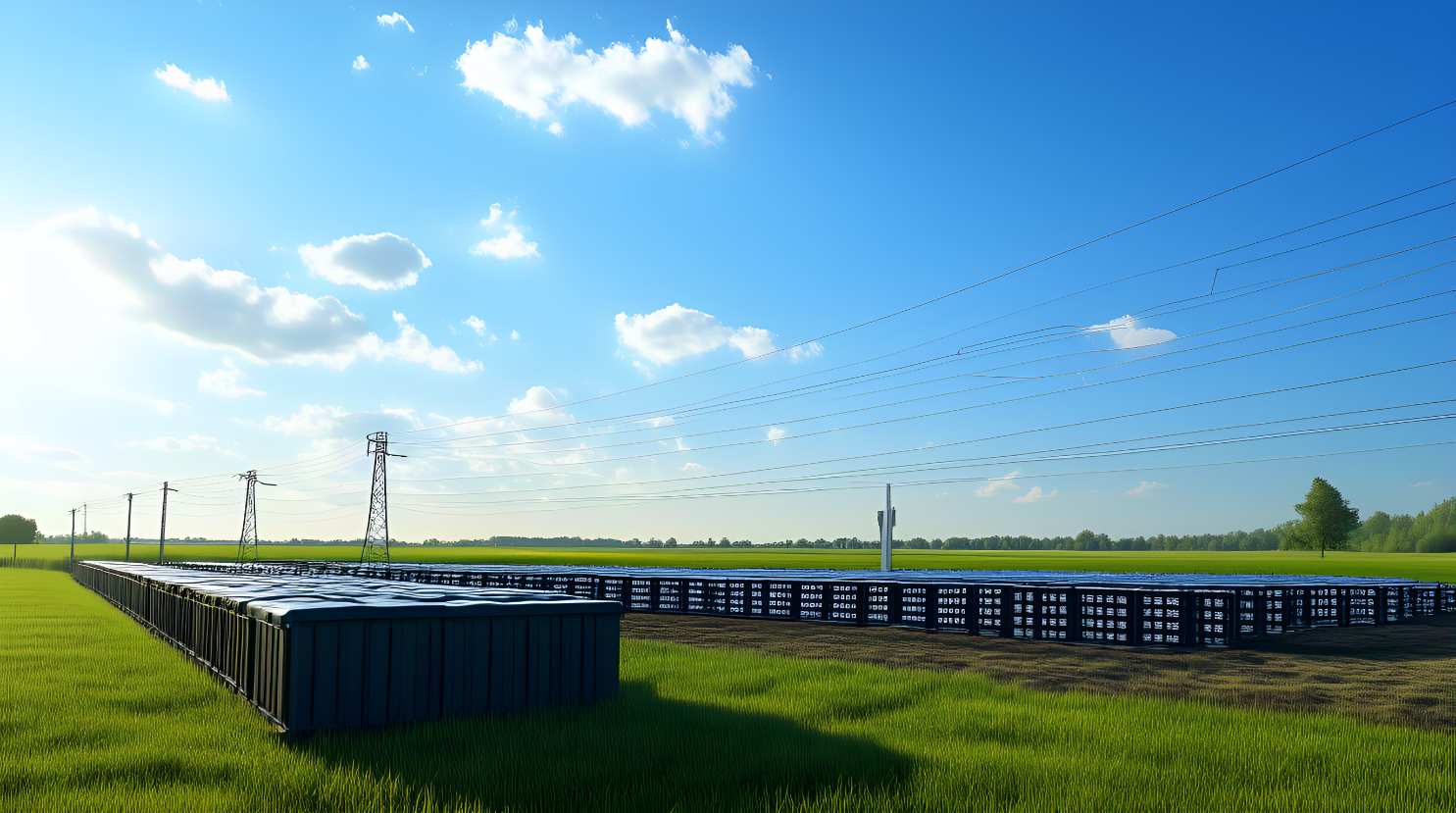
Commercial and industrial (C&I) energy storage continued to expand during the same period. According to the White Paper on China's Commercial and Industrial Energy Storage Development 2023, in 2022, the global cumulative installed capacity of new energy storage reached 46.2GW, of which the total installed capacity of commercial and industrial energy storage was 4.2GW, accounting for about 9.1% of the global cumulative installed capacity of new energy storage. And in 2023, China's newly installed capacity of commercial and industrial energy storage grew by more than 100%, though its share of total new installations remained significantly lower compared with grid-connected systems.
MARKET DATA SNAPSHOT: GRID-SCALE DOMINANCE
Utility-scale energy storage remained the dominant segment. According to relevant data, the US energy storage market, as the second largest market in the world, has maintained a high development trend of utility-scale energy storage for years, and it will still keep the market feature dominated by utility-scale energy storage in the future. In new installations across major energy markets, including North America, China, and parts of Europe, where grid flexibility requirements and renewable integration targets continue to drive large-scale deployment. According to relevant data, in 2024, the newly installed capacity of energy storage in China, the United States, and Europe reached 118.7GWh, a year-on-year increase of about 199% compared with 2022. Among them, China's newly installed capacity of energy storage in 2024 was 46.3GWh, a year-on-year increase of about 215% compared with 2022. In 2024, the newly installed capacity of energy storage in Europe reached 11.9GW/21.1GWh, and that in the United States reached 12.3GW/37.1GWh, both hitting record highs. In January 2025, China's new energy storage system scale reached 3.9GW/9.52GWh, accounting for 68% of the global newly installed capacity and 75% of the energy storage capacity, continuing to dominate the global energy storage deployment.
|
Year |
Global New Energy Storage Installed Capacity (GWh) |
China New Energy Storage Installed Capacity (GWh) |
US New Energy Storage Installed Capacity (GWh) |
Europe New Energy Storage Installed Capacity (GWh) |
Global C&I Energy Storage Newly Installed Capacity Share |
China C&I Energy Storage New Installed Capacity Share |
Grid-Scale Energy Storage Global New Installed Capacity Share |
|
2020 |
19.2 |
2.3 |
1.4 |
2.8 |
14.8% |
12.1% |
62.3% |
|
2021 |
39.7 |
5.5 |
3.1 |
5.2 |
18.2% |
15.3% |
65.7% |
|
2022 |
59.7 |
14.7 |
4.6 |
8.1 |
22.5% |
19.8% |
68.2% |
|
2023 |
85.1 |
29.4 |
8.9 |
14.3 |
28.7% |
26.2% |
69.5% |
|
2024 |
118.7 |
46.3 |
37.1 |
21.1 |
32.4% |
30.1% |
70.2% |
|
2025 (Jan Only) |
14.0 |
9.52 |
2.1 |
1.8 |
34.7% |
32.5% |
71.0% |
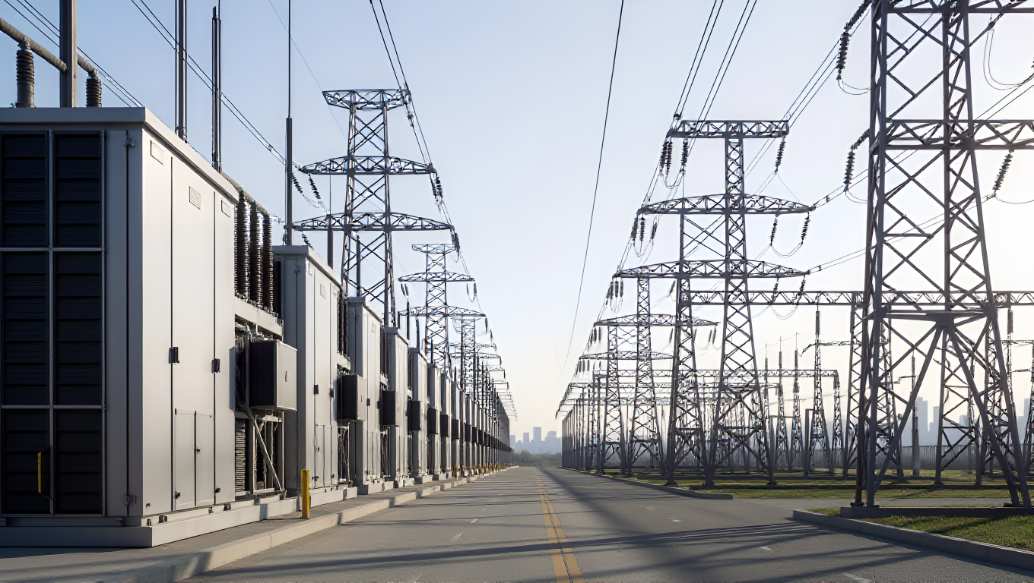
Industry estimates and domestic market data show that grid-scale systems accounted for the majority of new battery energy storage capacity additions, surpassing distributed and behind-the-meter installations by a wide margin. According to CESA data, in the first half of 2024, the installed capacity of grid-side independent/shared energy storage in China reached 20.33GWh, accounting for 65% of the new installed capacity, and the proportion of new grid-side installed capacity further increased to 76% in Q3. In addition, statistics from the China Electricity Council show that in the first half of 2024, new grid-side energy storage (mainly independent energy storage) reached 6.85GW, a year-on-year increase of over 100%, accounting for 66% of the total installed capacity.
Behind-the-meter energy storage systems, which include distributed energy resources such as rooftop solar and small-scale battery units Storage systems deployed at commercial and industrial facilities continued to show steady expansion: according to EESA data, the global new installed capacity of commercial and industrial energy storage increased from 0.7 GWh in 2021 to 7.8 GWh in 2023, with an average growth rate of 169%, and it is expected to reach 12.7 GWh in 2024. However, it remained secondary in terms of total installed capacity. In 2024, the global deployed energy storage system capacity reached 205 GWh, of which the grid-scale energy storage market accounted for more than 160 GWh, far exceeding the scale of commercial and industrial energy storage.
STRUCTURAL SHIFT IN ENERGY STORAGE DEPLOYMENT
Against the backdrop of the continuous rise in the global proportion of renewable energy - in 2021, wind and solar power generation accounted for 10.3% of the total - the volatility and randomness of renewable energy have brought challenges to grid stability and power consumption. As a result, the energy storage industry is increasingly shifting away from a deployment model primarily driven by renewable energy pairing toward one centered on grid-level system support. After all, energy storage, with its energy storage and release adjustment functions, is an important part of building a new power system and can effectively improve the stability of the power system.
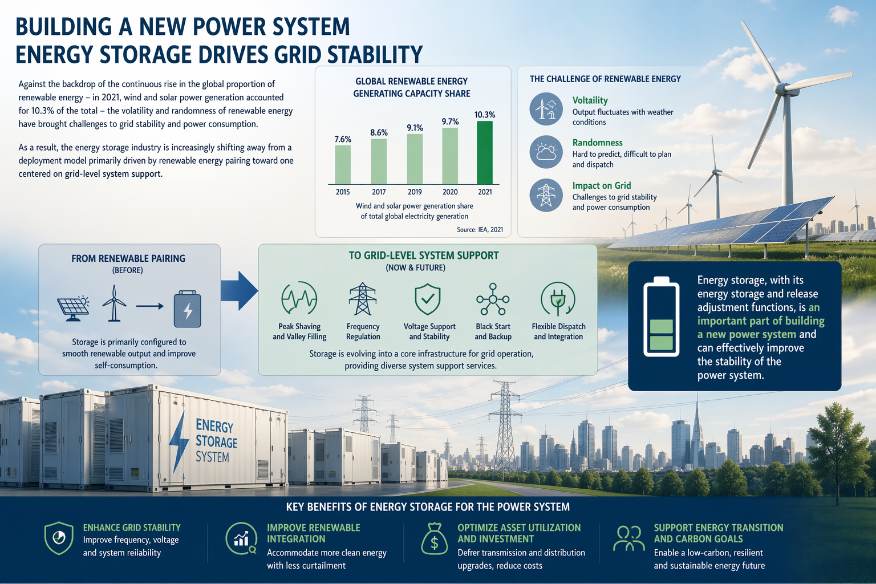
Historically, energy storage projects were largely developed as complementary assets to wind and solar installations. installations, intended to mitigate intermittency and improve renewable dispatchability.
However, more recent deployment patterns indicate that energy storage is increasingly being treated as a standalone grid resource, contributing directly to system balancing, peak load management, and ancillary services. According to market intelligence firm Rho Motion, the global grid-scale battery energy storage market saw a 68% year-on-year growth in 2024, expanding from 96GWh to 160GWh. In the same year, 17 energy storage projects with a capacity of over 1GWh were put into operation worldwide, compared to only 4 such projects in 2023, which fully reflects the rapid development of energy storage as an independent grid resource.
This transition has been particularly evident in markets where grid congestion, electrification demand, and renewable penetration levels have increased pressure on system operators. For example, in China, the large-scale integration of renewable energy, such as wind and solar power, has brought challenges like volatility, intermittency, and unpredictability to the safe and stable operation of the power grid. Meanwhile, due to factors such as dual control of energy consumption, high thermal coal prices, and special weather, power outages occurred in many provinces in 2021 and 2022. According to the prediction of the Electric Power Planning and Engineering Institute, the number of regions with power supply tension will increase to 6 and 7 in 2023 and 2024, respectively. In addition, the difficulty in grid connection and the consumption of wind and solar power have also forced the acceleration of energy storage technology promotion, and the change of social power consumption structure has intensified the peak-shaving pressure on the power supply side.
SEGMENT ANALYSIS: C&I ENERGY STORAGE GROWTH
Commercial and industrial energy storage continued to record the fastest percentage growth among major application segments. According to the data from the Energy Storage Association (ESA), in 2023, the global installed capacity of commercial and industrial energy storage reached 12.4 GW, with a year-on-year growth of 48%, accounting for 38% of the global energy storage market, and it is expected to reach 31.6 GW by 2025, with an average annual growth rate of 26%. This growth is supported by rising electricity costs, demand-side management requirements, and increased adoption of behind-the-meter solutions. For example, in China, the newly installed capacity of commercial and industrial energy storage was about 2.5 GWh in 2023, with a year-on-year growth of over 150%; in Europe, the demand for commercial and industrial photovoltaic-storage systems has surged after the energy crisis, while the US ITC tax credit policy has stimulated investment in this field. In addition, many countries and regions have launched policies and projects to promote behind-the-meter solutions, such as California's SGIP program, which provides up to 50% storage subsidies to encourage users to install distributed energy storage equipment.
While C&I (commercial and industrial) energy storage systems remain smaller in absolute scale compared with grid-connected deployments, their continuous expansion reflects a growing emphasis on localized energy optimization strategies. According to the White Paper on China's Commercial and Industrial Energy Storage Development 2023, the global cumulative installed capacity of C&I energy storage is expected to reach 11.5GW by 2025, with the cumulative market size estimated to be between 19 billion and 24 billion yuan. Meanwhile, data from the International Storage Alliance (ISA) shows that the global C&I energy storage system market size reached 10 billion US dollars in 2019 and is expected to grow to 40 billion US dollars by 2025, with a compound annual growth rate of 25%.
In In particular, distributed energy storage systems are being increasingly adopted by industrial facilities, data centers, and commercial buildings seeking to cut peak demand charges and enhance energy resilience.
Despite this growth trajectory, the segment’s overall contribution to total installed capacity remains significantly lower than that of utility-scale systems. According to relevant data, as of the end of 2021, the cumulative installed capacity of pumped storage, a typical utility-scale energy storage system, accounted for 86.2% of the global total installed capacity of energy storage projects, while the cumulative installed capacity of new energy storage, represented by lithium-ion batteries, only accounted for 12.2%. By the end of 2023, the cumulative installed capacity of pumped storage still accounted for 67% of the global total, maintaining a dominant position.
SEGMENT ANALYSIS: GRID-SCALE ENERGY STORAGE
Large-scale battery energy storage system deployments are increasingly integrated into transmission-level infrastructure, where they provide services such as frequency regulation, voltage support, and capacity firming.
The expansion of grid-scale projects has been supported by evolving regulatory frameworks in multiple regions, where energy storage is increasingly recognized as a core grid asset rather than a supplementary technology. For example, in November 2024 alone, 26 provinces and cities in China issued 40 energy storage-related policies, covering power market regulation, industrial development planning, and other aspects. Moreover, in 2024, "new energy storage" was written into the government work report for the first time in China, which has strongly injected impetus into the development of the industry, further confirming the core position of energy storage in the power system.
This shift in regulatory perception has fostered an expanding pipeline of utility-scale projects, especially in markets with high renewable energy penetration and rising electrification across end-use sectors.
MARKET STRUCTURE: DIVERGENCE BETWEEN GRID AND C&I
The energy storage market is showing increasing structural divergence between grid-scale and commercial and industrial applications. Data shows that in 2023, the newly installed capacity of grid-side and commercial and industrial energy storage in China both increased by more than 100%, while the commercial and industrial energy storage in the U.S. achieved a growth of more than 7 times. From January to April 2024, the newly installed capacity of grid-side energy storage projects in the U.S. increased by 185.73% compared with the same period in 2023. In Europe, the newly installed capacity of large-scale energy storage is expected to surpass residential energy storage to become the main growth driver of the energy storage market in 2024.
Grid-scale systems are primarily deployed as system-level infrastructure assets designed to enhance grid reliability and flexibility. According to relevant statistics, by the end of 2023, the total power of grid-side energy storage in China reached 12.02GW, accounting for 48.09% of the total electrochemical energy storage, and the newly added total power in 2023 was 9.59GW, accounting for 52.93%. Grid-side energy storage is mainly dominated by independent energy storage, which effectively supports the grid's regulation capacity. Meanwhile, against the backdrop of the 'double carbon' goal, the proportion of new energy such as wind power and photovoltaic power in China's power generation installed capacity reached 30% by the end of 2022, and their intermittent and volatile characteristics have brought great pressure to the power system, making the deployment of grid-scale systems more critical. In 2023, the number of 100MW-level new energy storage projects connected to the grid in China increased by 370% year-on-year, and the application on the source and grid side dominated, further demonstrating the important role of grid-scale systems in enhancing grid reliability and flexibility, while C&I systems are increasingly focused on end-user cost optimization and energy management.
This divergence reflects fundamentally different economic drivers, with grid-scale projects typically dependent on wholesale electricity markets and ancillary service revenues, as seen in the UK's ancillary service market where mechanisms like the Short-term Operation Reserve (STOR) service provide clear operational and compensation models for such revenue streams, while C&I systems are more closely tied to retail electricity pricing structures and tariff arbitrage opportunities.
As a result, the two segments are increasingly developing along separate investment and deployment pathways rather than converging. Taking the power industry as an example, according to relevant data, in the second quarter, the fixed-asset investment in the power industry decreased by 8.2% year-on-year, with a significant divergence between the power source segment and the power grid segment. The investment in the power source segment dropped by about 20% year-on-year, while that in the power grid segment still maintained a slight growth. Moreover, the power source investment tends to be more diversified, with the proportion of investment in new thermal power, coal and coal chemical industries decreasing, while the proportion of investment in upgrading and transforming existing production capacity increasing; in the power grid field, the construction of UHV grids, which was controversial before, has been highly recognized by the policy, and the investment intensity will be strengthened. In addition, fields such as pumped storage power stations and distribution networks are also expected to attract more investment. competing directly within a single unified market structure.
EMERGING BUSINESS MODEL EVOLUTION
Revenue models for energy storage systems continue to evolve as market structures mature and regulatory frameworks adapt to higher levels of renewable penetration. For example, in mature markets like the US, UK, and Australia, energy storage revenue is currently dominated by electricity energy trading and frequency regulation, with the proportion of energy trading expected to rise in the future. In China, under the framework of the 14th Five-Year Plan, driven by policies such as mandatory energy storage allocation and local subsidies, the revenue models of independent energy storage power stations are becoming increasingly diverse as the electricity market reform progresses. Globally, major countries supporting energy storage development are also clarifying the functional positioning of energy storage by improving electricity market rules, enabling energy storage to gain a reasonable identity in the electricity market, which further promotes the evolution of its revenue models.
In the grid-scale segment, battery energy storage systems are increasingly monetized through participation in multiple revenue streams. For example, they can provide frequency regulation services to obtain frequency regulation mileage compensation, get capacity compensation fees in regions with capacity markets, and gain profits through energy arbitrage, such as peak-valley arbitrage, which is quite profitable in areas with large peak-valley price differences like Zhejiang and Guangdong. According to relevant data, in 2020, the proportion of grid-side energy storage installed capacity for peak regulation and frequency regulation in China reached 27%, and the peak regulation fee in the first half of 2019 increased by 125% year-on-year, reaching 4.525 billion yuan, accounting for 34.7% of all compensation fees.
In contrast, commercial and industrial energy storage systems primarily derive value from peak shaving, demand charge reduction, and load shifting applications.
Industry participants note that this divergence in revenue structure is contributing to a broader redefinition of how energy storage assets are financed, operated, and integrated into power systems.
However, the long-term profitability of both segments remains closely tied to evolving electricity market design and regulatory frameworks. frameworks.
SUPPLY CHAIN AND MANUFACTURING IMPACT
The shift toward grid-scale deployment is also reshaping upstream supply chains across the battery energy storage ecosystem.
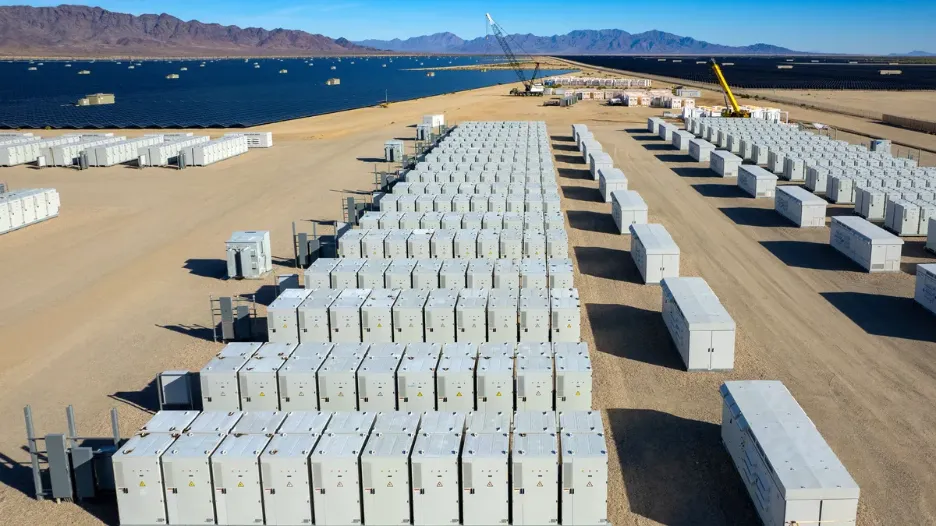
Against the backdrop of booming global energy storage demand, manufacturers of lithium-ion battery cells, battery modules, and integrated storage systems are increasingly aligning production capacity with utility-scale project requirements, which typically demand higher energy density systems, longer cycle life, and enhanced thermal management capabilities. Data shows that in 2024, the global energy storage cell capacity reached 607GWh, and the system integration supporting capacity was simultaneously increased to 436GWh, with leading manufacturers expanding production capacity and iterating products to seize market opportunities. Moreover, 500Ah+ energy storage cells are expected to be mass-produced in the second half of 2025, and as of early 2025, China's new energy storage production capacity exceeded 332GWh in just two months, with cell manufacturers extending to downstream system integration fields, which fully reflects the industry's response to the technical and capacity needs of large-scale projects.
Battery energy storage system manufacturers are also adjusting product portfolios to accommodate the growing share of large-scale grid-connected projects, which often require standardized containerized systems and modular deployment architectures. According to data from TrendForce, the global newly installed capacity of large-scale energy storage is expected to reach 55GW/133.7GWh in 2024, with a year-on-year growth of 33%/38%. China and the United States are the main markets for large-scale grid-connected projects, and the European market is also expected to see rapid growth in installed capacity.
Meanwhile, demand from the C&I segment continues to drive diversification in system design, especially in regions where distributed energy resources play a more significant role in maintaining local grid stability.
MARKET OUTLOOK: STRUCTURAL DIVERGENCE CONTINUES
Is the Energy Storage Price War Finally Over as Battery Prices Rise and Margins Recover?
2026 Energy Storage Shock: Grid-Scale Boom Takes Over While Profitability Finally Returns
Related Article

contact us
For more questions please


Office Address: 701, Building A, Yonghuayuan Business Building, Baotian 2nd Road, Chentian Community, Xixiang Street, Bao'an District, Shenzhen, Guangdong Province, China
Factory Address 1: Room 701, Building 2, Kegu Industrial Park, Zone B, Jian'an Road, No. 790, Chang'an Town, Dongguan City, Guangdong Province, China
Factory Address 2: Building 7, Phase II Standardized Factory, Innovation Industrial Park, Duji Economic Development Zone, Huaibei City, Anhui Province, China