


PCENERSYS BOLG
Lithium Ion Battery Cell Guide: Types, Voltage, Chemistry & How to Choose
Lithium ion battery cells are the fundamental building blocks of modern rechargeable battery systems. They are used in electric vehicles, portable electronics, backup power systems, and increasingly in residential, commercial, and utility-scale energy storage.
However, choosing a lithium ion battery cell is more complicated than comparing voltage or capacity. Cell chemistry, form factor, cycle life, C-rate, internal resistance, operating temperature, safety requirements, and application conditions all affect whether a cell is suitable for a specific battery system.
For energy storage applications, LiFePO₄ (LFP) lithium ion cells have become particularly important because of their combination of safety, long cycle life, thermal stability, and suitability for frequent charge and discharge operation.
This guide explains what a lithium ion battery cell is, how it works, the main cell types and chemistries, voltage characteristics, key specifications, and how to select lithium ion cells for energy storage applications.
What Is a Lithium Ion Battery Cell?
A lithium ion battery cell is a single electrochemical unit that stores and releases electrical energy through the reversible movement of lithium ions between the positive and negative electrodes.
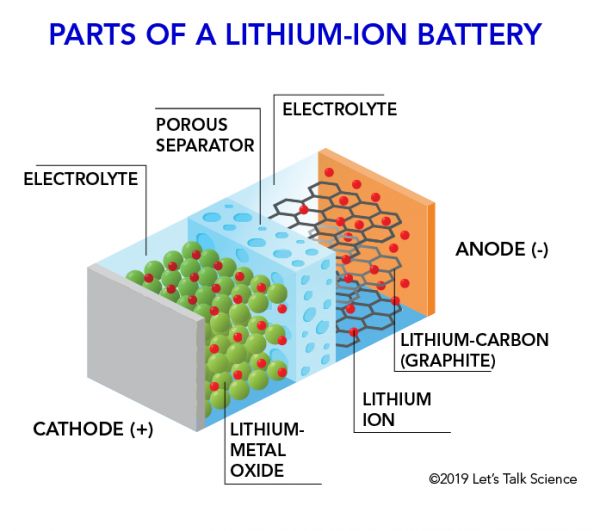
A typical lithium ion cell contains four primary components:
- Cathode: Determines much of the cell's voltage, energy density, and chemical characteristics.
- Anode: Commonly graphite in conventional lithium ion cells and serves as the host material for lithium ions during charging.
- Electrolyte: Provides a medium through which lithium ions move between the electrodes.
- Separator: Keeps the electrodes physically separated while allowing lithium ions to pass through.
During charging, lithium ions move from the cathode toward the anode. During discharge, the ions move in the opposite direction while electrons travel through the external circuit to provide usable electrical power.
The cell is the basic electrochemical unit. Multiple cells can then be connected in series and parallel to create modules and battery packs with higher voltage and capacity.
Cell vs Module vs Battery Pack vs BESS
Understanding this hierarchy is important when discussing lithium ion battery systems.
|
Level |
Description |
Main Function |
|
Cell |
Single electrochemical unit |
Stores and releases energy |
|
Module |
Multiple cells connected together |
Builds voltage/capacity and provides mechanical structure |
|
Battery Pack |
Cells or modules with BMS and supporting components |
Provides controlled electrical power |
|
BESS |
Battery pack plus PCS, EMS, thermal management, protection and other systems |
Complete energy storage solution |
For example, a single LiFePO₄ cell may have a nominal voltage of 3.2V, while multiple cells connected in series can create a 51.2V battery or a much higher-voltage battery system.

How Does a Lithium Ion Cell Work?
A lithium ion cell works through the coordinated movement of lithium ions inside the cell and electrons through an external electrical circuit.
During Charging
When an external power source charges the cell:
- Lithium ions move from the cathode toward the anode.
- The electrolyte allows lithium ions to travel between the electrodes.
- Electrons move through the external charging circuit.
- Energy is stored as chemical potential energy.
During Discharging
When the cell powers a load:
- Lithium ions move from the anode toward the cathode.
- Electrons flow through the external circuit.
- The electrical current supplies energy to the connected equipment.
This reversible process allows lithium ion cells to be repeatedly charged and discharged.
For energy storage systems, however, cell performance depends on more than the electrochemical reaction itself. Operating temperature, depth of discharge, charge/discharge rate, cell balancing, and battery management all affect long-term performance.
Types of Lithium Ion Battery Cells
Lithium ion cells are commonly categorized by physical form factor. The three major formats are cylindrical, prismatic, and pouch cells.
Cylindrical Lithium Ion Cells
Cylindrical cells are manufactured in standardized cylindrical formats such as 18650 and 21700.
Their advantages include:
- Robust metal housing
- Mature manufacturing processes
- Consistent mechanical structure
- Good thermal management potential
- High production scalability
Cylindrical cells are widely used in portable electronics, power tools, electric vehicles, and some battery systems.
Prismatic Lithium Ion Cells
Prismatic cells use a rigid rectangular housing, commonly made from aluminum.
Compared with cylindrical cells, prismatic cells can provide better space utilization for applications requiring large-capacity cells.
They are particularly common in:
- Energy storage systems
- Electric vehicles
- Commercial battery packs
- Industrial backup power
Large-format prismatic LiFePO₄ cells are widely used in stationary energy storage because fewer cells may be required to build a battery pack of a given capacity.
Pouch Lithium Ion Cells
Pouch cells use a flexible laminated enclosure rather than a rigid metal case.
Their main advantages include:
- Low weight
- Efficient packaging
- Flexible form factor
- High packaging efficiency
However, pouch cells require appropriate mechanical support and thermal management because the flexible enclosure provides less structural protection than rigid cylindrical or prismatic housings.
Cylindrical vs Prismatic vs Pouch
|
Feature |
Cylindrical |
Prismatic |
Pouch |
|
Housing |
Metal cylinder |
Rigid metal case |
Flexible pouch |
|
Mechanical strength |
High |
High |
Lower |
|
Packaging efficiency |
Medium |
High |
High |
|
Manufacturing maturity |
Very high |
High |
High |
|
Common applications |
EVs, tools, electronics |
ESS, EVs |
Electronics, EVs |
|
Large-format ESS suitability |
Medium |
High |
Application-dependent |
For large stationary energy storage, prismatic LiFePO₄ cells are particularly attractive because of their large capacity, structural strength, long cycle life, and efficient system integration.
Lithium Ion Battery Cell Chemistry
Cell chemistry is one of the most important factors when selecting a lithium ion battery cell.
Different chemistries offer different combinations of energy density, safety, cycle life, power capability, and cost.
LFP Lithium Ion Cells
Lithium iron phosphate (LiFePO₄ or LFP) cells are widely used in energy storage.
Key advantages include:
- High thermal stability
- Strong safety characteristics
- Long cycle life
- Good cost efficiency
- Suitable performance for frequent cycling
LFP has a lower nominal voltage and generally lower gravimetric energy density than some NMC cells, but its long service life and safety characteristics make it particularly suitable for stationary energy storage.
For example, PCEnerSys lists its LF280LA cell as a 3.2V, 280Ah LiFePO₄ cell with a stated cycle life of 6000+ cycles under specified test conditions.
NMC Lithium Ion Cells
Nickel manganese cobalt oxide (NMC) cells offer higher energy density than LFP in many cell designs.
They are commonly considered when:
- Space and weight are important
- High energy density is required
- The application requires a compact battery pack
NMC cells have been widely used in electric vehicles and consumer electronics.
LTO Lithium Ion Cells
Lithium titanate (LTO) cells use lithium titanate as the anode material.
Their notable characteristics include:
- Very long cycle life
- High power capability
- Fast charging potential
- Strong low-temperature performance
The main trade-off is lower energy density and typically higher cost compared with mainstream LFP and NMC technologies.
LFP vs NMC vs LTO
|
Characteristic |
LFP |
NMC |
LTO |
|
Energy density |
Medium |
High |
Low |
|
Safety/thermal stability |
High |
Medium |
Very high |
|
Cycle life |
High |
Medium–High |
Very high |
|
Fast charging |
Good |
Good |
Excellent |
|
Typical application |
ESS, EV |
EV, electronics |
Specialized high-cycle applications |
|
Main advantage |
Safety + lifespan |
Energy density |
Power + durability |
There is no universally “best” lithium ion battery chemistry. The correct choice depends on the application's operating profile and technical requirements.
Lithium Ion Cell Voltage Explained
Voltage is one of the most important specifications when designing or selecting lithium ion cells.
Nominal Voltage
Typical nominal voltages include:
|
Chemistry |
Typical Nominal Voltage |
|
LFP |
3.2V |
|
NMC |
3.6–3.7V |
|
LTO |
2.3–2.4V |
The nominal voltage is a representative operating voltage, not the maximum or minimum voltage of the cell.
For example, PCEnerSys's LF280LA LFP cell has a nominal voltage of 3.2V, with specified charge/discharge cutoff voltages of 3.65V and 2.5V respectively.
Why Lithium Ion Cell Voltage Matters
Cell voltage directly affects battery system architecture.
Cells connected in series increase voltage:
Pack Voltage ≈ Cell Voltage × Number of Cells in Series
For example:
16 × 3.2V LFP cells = 51.2V nominal battery
Cells connected in parallel increase capacity:
Pack Capacity ≈ Cell Capacity × Number of Parallel Cells
This series-parallel architecture allows manufacturers to build battery packs for different inverter, PCS, EV, and energy storage requirements.
Key Lithium Ion Battery Cell Specifications
Voltage alone is not enough to determine whether a cell is suitable for an application.
Capacity (Ah)
Capacity measures the amount of electrical charge a cell can deliver.
For example, a 280Ah cell has a nominal capacity of 280 amp-hours under specified test conditions.
Energy (Wh)
Cell energy can be estimated using:
Energy (Wh) = Voltage (V) × Capacity (Ah)
For a 3.2V, 280Ah LFP cell:
3.2 × 280 = 896Wh
Actual usable energy depends on operating voltage, depth of discharge, temperature, efficiency, and system limits.
C-Rate
C-rate describes the charge or discharge rate relative to the cell's nominal capacity.
For a 280Ah cell:
- 0.5C ≈ 140A
- 1C ≈ 280A
- 2C ≈ 560A
Higher C-rates can increase power capability, but they can also increase heat generation and influence cell degradation. The allowable rate must therefore follow the manufacturer's specifications.
Cycle Life
Cycle life represents how many charge-discharge cycles a cell can complete before reaching a defined performance threshold.
Cycle-life figures are meaningful only when the test conditions are understood. Temperature, charge/discharge rate, depth of discharge, and end-of-life criteria can significantly affect the result.
Internal Resistance
Low internal resistance generally helps reduce:
- Voltage drop
- Heat generation
- Power losses
Cell consistency is also important. In a battery pack containing many cells, significant variation in voltage, capacity, or resistance can affect balancing and overall pack performance.
Operating Temperature
Temperature has a direct impact on battery performance and aging.
A cell specification should therefore be evaluated based on:
- Charging temperature
- Discharging temperature
- Storage temperature
- Thermal management requirements
For example, PCEnerSys specifies different charging and discharging temperature ranges for its LF280LA cell, demonstrating why temperature specifications should be evaluated together with electrical parameters.
Lithium Ion Battery Cells for Energy Storage
Energy storage places different requirements on lithium ion cells than consumer electronics.
A stationary energy storage battery may perform thousands of charge and discharge cycles over many years. Therefore, cycle life, safety, consistency, thermal stability, and total cost of ownership can be more important than maximizing energy density.
Residential Energy Storage
Lithium ion cells can be assembled into batteries for:
- Solar self-consumption
- Backup power
- Time-of-use energy management
- Off-grid applications
Commercial and Industrial Energy Storage
C&I systems use battery storage for applications such as:
- Peak shaving
- Load shifting
- Backup power
- Renewable energy integration
- Demand management
Utility-Scale BESS
Large-scale battery energy storage systems require thousands of cells or more, depending on system architecture.
At this scale, cell consistency and quality control become especially important because variations across large numbers of cells can influence system performance and maintenance requirements.
PCEnerSys currently offers lithium ion cells including 100Ah and 280Ah LiFePO₄ formats for energy storage applications, alongside complete low- and high-voltage storage systems.
How to Choose the Right Lithium Ion Battery Cell
Selecting a lithium ion battery cell should begin with the application rather than the cell itself.
1. Define the Application
Determine whether the cell will be used for:
- Residential ESS
- C&I energy storage
- Utility-scale BESS
- EVs
- Backup power
- Portable equipment
Each application has different requirements.
2. Select the Chemistry
For stationary energy storage, LFP is often attractive because of its combination of safety, cycle life, and cost efficiency.
For applications where maximum energy density is the priority, NMC may be more appropriate.
3. Determine Voltage and Capacity
Calculate the required battery voltage and energy first, then determine the number of cells needed in series and parallel.
4. Evaluate Cycle Life
Do not compare cycle-life numbers without checking:
- Temperature
- C-rate
- Depth of discharge
- End-of-life capacity
- Test methodology
5. Check Cell Consistency
For battery pack manufacturing, evaluate:
- Voltage consistency
- Capacity consistency
- Internal resistance
- Production batch consistency
Consistent cells help simplify balancing and improve pack reliability.
6. Verify Certifications and Documentation
For commercial procurement, request appropriate documentation such as:
- Product datasheets
- Test reports
- Safety documentation
- UN38.3 documentation where applicable
- Relevant management-system or product certifications
Certification requirements depend on the market, transportation method, and application, so buyers should verify the standards applicable to their project.
What to Check When Buying Lithium Ion Cells in Bulk
For B2B buyers, purchasing lithium ion battery cells is not simply a price comparison.
A supplier evaluation should include:
- Cell manufacturer and model
- Cell chemistry
- Nominal voltage and capacity
- Cycle-life test conditions
- Internal resistance
- Production date and batch traceability
- Grade and cell consistency
- Certifications and test documentation
- MOQ and supply capacity
- Long-term availability of the cell model
A reliable supplier should be able to provide technical documentation and clearly define the conditions behind published specifications.
For example, PCEnerSys identifies its LF280LA as a Grade A EVE LiFePO₄ cell and publishes detailed electrical, thermal, cycle-life, and certification information rather than relying only on headline capacity.
Lithium Ion Cell vs Lithium Ion Battery
The terms lithium ion cell and lithium ion battery are often used interchangeably in general conversation, but they have different technical meanings.
|
Feature |
Lithium Ion Cell |
Lithium Ion Battery |
|
Basic structure |
Single electrochemical unit |
Multiple cells and supporting components |
|
Voltage |
Determined by chemistry |
Determined by cell configuration |
|
Capacity |
Cell-level capacity |
Pack-level capacity |
|
BMS |
Usually external at pack level |
Commonly integrated |
|
Application |
Building block |
Complete power source |
A battery pack can contain cells connected in series, parallel, or a combination of both.
For energy storage, the battery itself is only one part of the overall system. A complete BESS may also include a BMS, PCS, EMS, thermal management, protection equipment, fire safety systems, and other balance-of-system components.
FAQ About Lithium Ion Battery Cells
What is a lithium ion battery cell?
A lithium ion battery cell is a single rechargeable electrochemical unit that stores and releases energy through the reversible movement of lithium ions.
What is the voltage of a lithium ion cell?
Voltage depends on chemistry. LFP cells typically have a nominal voltage of about 3.2V, while NMC cells are commonly around 3.6–3.7V.
What is the difference between a lithium ion cell and a battery?
A cell is a single electrochemical unit. A battery combines multiple cells and supporting components to achieve the required voltage, capacity, protection, and control functions.
Which lithium ion cells are best for energy storage?
LFP cells are widely suited to energy storage because they combine strong thermal stability, safety characteristics, and long cycle life. The final choice should still be based on project requirements.
How many lithium ion cells are needed for a battery?
The number depends on the required voltage and capacity. Cells are connected in series to increase voltage and in parallel to increase capacity.
What specifications should I compare when buying lithium ion cells?
At minimum, compare chemistry, nominal voltage, capacity, C-rate, cycle life, internal resistance, operating temperature, dimensions, consistency, certifications, and test conditions.
Can lithium ion battery cells be purchased in bulk?
Yes. Industrial buyers can source lithium ion cells in bulk, but should evaluate supplier quality, batch consistency, documentation, MOQ, certifications, and long-term supply capability rather than price alone.
Conclusion
A lithium ion battery cell is the fundamental electrochemical building block of modern rechargeable battery systems. However, selecting the right cell requires more than looking at nominal voltage or capacity.
For engineering and procurement decisions, the most important factors include cell chemistry, form factor, voltage, capacity, C-rate, cycle life, internal resistance, temperature range, safety, and cell consistency.
For energy storage applications, LFP lithium ion cells are particularly relevant because their combination of safety characteristics, thermal stability, and long cycle life aligns well with the requirements of residential ESS, commercial and industrial energy storage, and large-scale BESS.
The most effective approach is to start with the application's requirements, then select the chemistry, form factor, voltage, capacity, and performance specifications that match those requirements. For B2B buyers, supplier qualification, technical documentation, batch consistency, and long-term supply reliability should be evaluated alongside the cell's electrical specifications.
In other words, the best lithium ion battery cell is not necessarily the cell with the highest capacity or energy density—it is the cell whose technical characteristics, quality, and lifecycle economics best match the intended application.
The Future of Battery Industry: Why Energy Storage Is Overtaking EV Demand | PCENERSYS
How to Choose Solar Panels: A Complete Guide for Homes and Businesses | PCENERSYS


contact us
For more questions please


Office Address: 701, Building A, Yonghuayuan Business Building, Baotian 2nd Road, Chentian Community, Xixiang Street, Bao'an District, Shenzhen, Guangdong Province, China
Factory Address 1: Room 701, Building 2, Kegu Industrial Park, Zone B, Jian'an Road, No. 790, Chang'an Town, Dongguan City, Guangdong Province, China
Factory Address 2: Building 7, Phase II Standardized Factory, Innovation Industrial Park, Duji Economic Development Zone, Huaibei City, Anhui Province, China