


PCENERSYS BOLG
Solar-plus-Storage Heatwaves Guide: Prevent Thermal Degradation & Protect BESS Lifetime
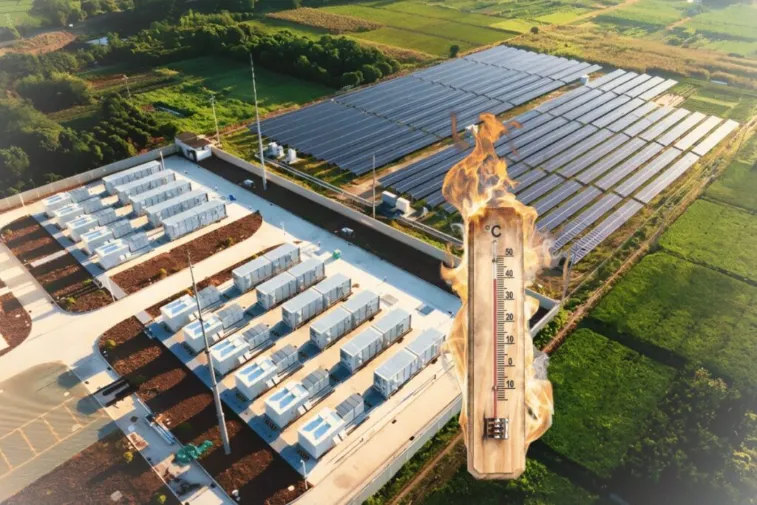
1. The "Revenue Paradox" of Solar-plus-Storage Assets in Summer
For many operators of solar photovoltaic (PV) and battery energy storage systems (BESS), midsummer often appears to be the most commercially attractive season: abundant sunlight drives PV generation to its peak, while surging cooling demands push up real-time electricity prices and revenues from grid ancillary services. However, the combination of "intense sunlight and high electricity prices" does not automatically equate to "maximum net revenue and optimal system health." This apparent prosperity masks a critical reality—extreme heat is quietly eroding the core value of these assets.
Resolving this paradox requires a clear distinction between "solar irradiance" and "ambient temperature." While intense sunlight indeed yields high current output, the accompanying extreme ambient heat and sustained thermal accumulation trigger severe thermal derating and accelerated degradation. On the PV side, excessive heat causes cell voltage drops and localized hot spots; on the storage side, the combination of high temperatures and high State of Charge (SoC) directly accelerates calendar aging and causes irreversible capacity loss in lithium-ion batteries.
Consequently, extreme heatwaves are not merely incidental seasonal weather events but serve as real-world "stress tests" for the hardware resilience and software dispatch strategies of solar-plus-storage systems. Ignoring the impact of temperature on physical asset limits—while blindly pursuing peak generation and short-term market arbitrage—often leads to skyrocketing maintenance costs and hundreds of thousands of dollars in losses due to premature equipment failure.
This article provides an in-depth analysis of the management logic for solar-plus-storage assets under extreme heat conditions. We begin by examining the physical mechanisms behind declining PV power coefficients and hot-spot effects, then analyze the calendar and cycle aging mechanisms of BESS batteries. We further explore the decision-making conflicts between dynamic revenue and asset lifespan for C&I (Commercial & Industrial) and utility-scale projects. Finally, we present seven practical O&M guidelines—covering EMS thermal management strategies, derating assessments, and data reviews—to help your solar-plus-storage assets maintain high efficiency, safety, and robust returns even amidst the challenges of extreme heat.
2. Physical Layer Diagnostics: PV Systems Under Thermal Stress—Degradation Calculation and Localized Risk Amplification
2.1 Quantifying Power Loss: Temperature Coefficients and Actual Output Degradation.
Blind reliance on nameplate capacity is a primary cause of discrepancies in revenue forecasting when assessing the actual output of PV systems. The rated power of solar modules is measured under Standard Test Conditions (STC: irradiance of 1000 W/m², air mass AM 1.5, and cell temperature of 25°C). However, during summer heatwaves, the actual operating cell temperature of the array often significantly exceeds the ambient air temperature, easily surpassing 65°C or even higher. The output power of crystalline silicon (c-Si) solar cells degrades linearly as temperature rises.
The extent of this change in physical performance depends on the module's power temperature coefficient; for typical monocrystalline PERC or TOPC on modules, this coefficient generally ranges from -0.35%/°C to -0.40%/°C. Based on the formula for the module's maximum power temperature coefficient:

Assume a power plant uses crystalline silicon modules with a temperature coefficient of -0.40%/°C; when the cell temperature rises from 25°C to 65°C (a temperature difference of 40°C):

This means that during the peak midday period—when solar irradiance is at its highest and the system should theoretically be generating power at full capacity—thermal losses alone result in the direct loss of more than 16% of the rated power output. Operators who focus solely on irradiance data while overlooking temperature correction will be unable to accurately assess the system's true Performance Ratio (PR).
2.2 Severe Exacerbation of the Hot Spot Effect
Extreme heat not only causes a system-wide drop in power output but also significantly amplifies existing physical defects within the photovoltaic (PV) array. In environments characterized by high temperatures and high irradiance, minor issues—such as dust accumulation, bird droppings, shading from birds, micro-cracks in cells, and current mismatch within series circuits—are drastically intensified.
When an individual cell or sub-string experiences a short-circuit current lower than that of other normal cells in the same string (due to shading or damage), the affected area cannot transmit current smoothly. Driven by the high current resulting from intense irradiance, the damaged cell is subjected to a forced reverse-bias voltage, transforming it from a power-generating unit into a load that consumes electrical energy. This localized electrical phenomenon rapidly generates intense, concentrated heat, triggering a severe hot spot effect.
During the summer, when ambient temperatures are already elevated, the local temperature in hot spot areas can quickly soar above 100°C. This not only causes yellowing and delamination of the EVA encapsulant, backsheet burn-through, and irreversible cell damage, but in extreme cases, it can also cause bypass diode breakdown and continuous arcing, creating a serious on-site fire hazard.
2.3 Cascading Bottlenecks in the Balance of Plant (BoP)
Beyond the PV modules themselves, high thermal stress causes irreversible performance degradation in the PV plant's Balance of Plant (BoP) systems, creating system-wide output bottlenecks:
Increased DC Cable Resistance (DC Cable Losses): The resistivity of copper and aluminum conductors rises significantly at high temperatures. Prolonged exposure to heat leads to a sharp increase in line losses (I²R losses) within DC collection circuits, further reducing the effective voltage reaching the DC side of the inverter.
Inverter Thermal Derating: When the temperature of the internal IGBT power modules or transformers reaches a critical upper limit (e.g., the internal heatsink reaching 75°C–85°C), the inverter’s protection logic automatically triggers an active derating mechanism. By limiting the maximum input current or adjusting active power output to prevent hardware burnout, this process effectively caps the power plant's peak output.
Accelerated Aging of Connectors and Junction Boxes: When DC junction boxes, MC4 connectors, and power distribution cabinets operate under high-temperature and high-load conditions for extended periods, insulation materials degrade more rapidly and contact resistance increases. This creates a vicious cycle of heat accumulation, potentially leading to connector melting and short circuits.
3. Physical Layer Diagnostics: Battery Energy Storage Systems (BESS) in Extreme Heat—Aging Mechanisms and Safety Thresholds
3.1 Dual Physical Mechanisms of Lithium-Ion Battery Aging: Calendar Aging vs. Cycle Aging
Capacity fade and performance degradation in Battery Energy Storage Systems (BESS) are driven by two parallel mechanisms: Calendar Aging (spontaneous chemical degradation during static, idle states) and Cycle Aging (electrochemical loss occurring during charge-discharge cycles).
During extreme heatwaves, high ambient temperatures (>35°C) exponentially accelerate the rupture and continuous thickening of the Solid Electrolyte Interphase (SEI) layer. Abnormal SEI thickening not only permanently depletes active lithium ions (Lithium Inventory Loss) but also sharply increases the internal impedance of battery cells, leading to a rapid reduction in the system's usable capacity.
Even more critical is the "Fatal Triad" phenomenon found in energy storage operational strategies:
- High Ambient Temperature
- High State of Charge (SoC >90%)
- Deep Cycling
In typical solar-plus-storage projects, energy storage systems are often rapidly charged to full capacity during the midday peak of photovoltaic (PV) generation. If batteries remain at a high SoC for extended periods in ambient temperatures exceeding 40°C without timely discharge or heat dissipation, the combined effect of high cathode potential and intense heat accumulation becomes a "silent killer" of both calendar and cycle life.
3.2 Auxiliary Power Consumption and RTE (Round-Trip Efficiency) Erosion
High temperatures not only erode the lifespan of battery assets but also directly diminish the project's immediate financial returns. During heatwaves, HVAC air-cooling units or chillers must operate continuously at full rated power, causing a surge in the energy storage container's auxiliary power consumption.
This internal power consumption is drawn directly from the grid or the PV source, significantly dragging down the system's overall Round-Trip Efficiency (RTE). While the physical RTE was initially projected to exceed 85%, the commercial RTE could drop significantly—to 75% or even lower—after accounting for the surge in self-consumed electricity required for cooling; this directly erodes the profit margins available through peak-valley arbitrage.
Regarding the choice of thermal management architecture, the performance gap between air cooling and liquid cooling becomes particularly pronounced under extreme high-temperature conditions:
|
Cooling Architecture |
Extreme High-Temperature Performance |
Temperature Control (ΔT) |
Thermal Dead Zone & Auxiliary Power Risks |
|
Air Cooling System |
Low heat capacity of gas; air convective heat dissipation efficiency drops dramatically as ambient temperature rises |
Battery module-to-module temperature delta (ΔT) can reach 5-8℃ |
Prone to local thermal dead zones; HVAC auxiliary power consumption increases non-linearly with temperature |
|
Liquid Cooling System |
High heat capacity of coolant medium; heat transfer efficiency is tens of times higher than air |
Precisely controls cell-to-cell temperature delta within ΔT≤3℃ |
High temperature uniformity; effectively prevents single-cell thermal mismatch and localized overheating degradation |
3.3 Safety Management and Thermal Runaway Prevention
Beyond electrochemical degradation and efficiency loss, extreme heat pushes the safety risks of energy storage systems to a critical threshold. Thermal runaway represents the most dangerous catastrophic event in BESS operations. Typical early physical precursors include:
Sudden changes in internal cell impedance and localized abnormal temperature spikes;
A rapid surge in internal pack pressure, accompanied by the release of off-gases (such as CO and volatile organic compounds).
It must be emphasized that even the most advanced Battery Management Systems (BMS) cannot—through software algorithms alone—fully eliminate the hazards triggered by internal manufacturing defects (e.g., electrode burrs, micro-short circuits, or separator damage) under high-temperature conditions. Software logic can only issue alarms or cut off circuits when anomalies occur; it cannot halt the self-propagating nature of internal electrochemical exothermic reactions.
Therefore, modern safety strategies must adhere to the systems engineering principle of "containing single-point failures to prevent propagation":
Utilizing robust physical thermal barriers to block heat transfer between modules;
Deploying ultra-early gas detection sensors alongside aerosol or heptafluoropropane (HFC-227ea) fire suppression systems;
Incorporating explosion-venting and pressure-relief pathways at the container level to ensure that a localized single-cell failure never escalates into a systemic catastrophe for the entire container.
4. System-Level Conflict: Operational Trade-offs in Solar-plus-Storage—Commercial Returns vs. Asset Lifespan
4.1 Conflicting Economic and Technical Signals
In solar-plus-storage projects, extreme high temperatures exacerbate the conflict between commercial electricity price signals and underlying physical constraints, triggering a critical operational dilemma:
Economic Drivers: Market algorithms favor rapid charging at maximum C-rates during the midday solar generation peak to capture low-cost or even negative-priced green energy. Subsequently, they discharge at full power during evening peak hours to capitalize on maximum price spreads or secure lucrative compensation for grid ancillary services.
Physical Toll: In ambient temperatures exceeding 40°C, forcing batteries to 100% State of Charge (SoC) and maintaining them in a fully charged, idle state for hours creates a severe synergistic effect between thermal stress and high-voltage stress. The physical cost of this high-heat, high-voltage environment is an exponential surge in the battery's calendar aging rate and the rapid erosion of the asset's residual value.
4.2 Limitations of Traditional EMS Strategies
The fundamental flaw of traditional Energy Management Systems (EMS) lies in their reliance on static dispatch algorithms. These systems execute charge/discharge commands based solely on preset time slots, real-time electricity prices, and simple SoC thresholds, completely disregarding on-site real-time thermal boundaries and dynamic degradation costs.
During summer heatwaves, this "thermal-blind" dispatch approach is highly destructive: even when internal container temperatures trigger warnings and cooling systems are operating at overload, traditional EMS units continue to force high-intensity charge/discharge cycles. Such crude strategies—which prioritize short-term power arbitrage while completely ignoring thermal-aware control—ultimately lead to significant premature aging and early capacity derating of the entire BESS asset.
 5. Solution Layer: 7 Key Engineering & O&M Guidelines for Heat Protection and Degradation Mitigation in PV-Storage Systems
To address the dual physical threats posed by extreme heat to photovoltaic (PV) and battery energy storage systems (BESS), asset owners and O&M teams must move beyond reactive fault handling and implement a full-lifecycle engineering and O&M framework focused on heat protection and degradation mitigation. The following are seven core steps to ensure system safety, stability, and high profitability during extreme heatwaves:
1. Targeted Shading & Micro-climate Design: Differentiated thermal management strategies must be implemented during site planning and layout. While shading directly compromises solar panel output and revenue, it is highly beneficial for BESS containers. Installing dedicated shading canopies or radiation-shielding covers over energy storage containers, inverters, and transformers to block direct midday sunlight can significantly reduce radiant heat accumulation on enclosure surfaces, alleviate the cooling load on HVAC systems, and markedly improve airflow dynamics.
2. Stress-Testing Control Logic: Evaluating control strategies solely on paper is insufficient. O&M teams should conduct on-site stress tests of the system's overall controllability under conditions combining extreme heat and high grid load. This involves verifying response accuracy to frequency and voltage regulation commands at the Point of Connection (POC), confirming the proper functioning of active and reactive power control and ramp rate limits, and ensuring clear logging and automatic adjustment logic when thermal derating limits are triggered.
3. Temperature-Corrected Performance Ratio (PR) Tracking: Avoid assessing PV system health based solely on raw yield data. Operators should adopt a calculation model for the Performance Ratio (PR) that is corrected using meteorological data. By filtering out the physical voltage drop caused by rising ambient temperatures (a loss of -0.4%/°C), O&M teams can accurately distinguish between power generation declines attributable to normal thermal effects and genuine equipment faults caused by localized dust accumulation, string mismatch, or module micro-cracks.
4. Establish a BESS thermal transparency and assessment system; high-quality energy storage O&M begins with full-stack "thermal transparency." It is essential to go beyond monitoring absolute peak temperatures—ranging from individual cells and modules to racks and containers—and instead conduct deep data mining on temperature gradients. Monitoring temperature differentials between cells enables the very early detection of potential faults such as airflow blockages, coolant leaks, air bubbles in piping, and sensor drift.
5. Dynamic SoC Window Reconfiguration and Intelligent Aging Control: Optimize EMS scheduling algorithms to move beyond static charge/discharge logic. During periods of extreme summer heat, reconfigure the SoC management window: use intelligent scheduling to avoid forcing batteries to remain at a high SoC (>90%) for extended periods during the hottest part of the day. While still meeting grid service requirements, prioritize pre-charging and discharging during cooler periods to significantly reduce lithium battery calendar aging caused by the combination of high voltage and high temperature.
6. Upgrade HVAC and Liquid Cooling Systems to Primary Assets: Elevate HVAC units or liquid chillers to the same status as core assets like battery packs and inverters. Cooling systems are not merely secondary auxiliary equipment but are lifelines that determine BESS life expectancy and operational safety. O&M plans must strictly include compressor status checks, refrigerant pressure monitoring, cooling pump redundancy tests, air duct filter cleaning, and periodic analysis of liquid cooling medium conductivity.
6. Industry Summary and Outlook
The Normalization of Extreme Weather: A New Challenge for the Bankability of Clean Energy Assets
Against the backdrop of global climate change, extreme heatwaves have ceased to be sporadic, seasonal anomalies; instead, they have become a standard operating condition that solar PV and energy storage plants must contend with in the long term. For project investors, EPC contractors, and asset managers, the resilience of solar-plus-storage systems against high-temperature stress and their ability to mitigate thermal degradation are now directly linked to project bankability and long-term Internal Rate of Return (IRR). Assets designed without regard for extreme weather—characterized by a "rough-and-ready" approach—will face significant risks of accelerated depreciation and default over their operational lifecycles.
From Passive Cooling to Active Intelligence: Physical Thermal Constraints Drive EMS Algorithm Upgrades
The future of integrated solar-plus-storage technology lies in breaking down the silos between hardware-level thermal management and software-driven trading strategies. The industry is inevitably shifting from passive physical cooling—reliant on HVAC systems—toward active, intelligent dispatch driven by thermal-aware Energy Management System (EMS) algorithms. By incorporating real-time physical thermal constraints of batteries and PV modules into trading algorithms for price arbitrage and grid response, solar-plus-storage plants can maximize market returns while simultaneously optimizing asset safety and service life.
7. Frequently Asked Questions (FAQ)
Q1: How much power output does a solar panel lose during extreme summer heat?
A: During extreme summer heat, PV panel temperatures often soar above 65°C, causing actual power output to drop by 14% to 16%. This is due to the negative power temperature coefficient inherent in crystalline silicon modules. Additionally, high temperatures significantly increase the risk of localized "hot spots," which can cause permanent module damage.
Q2: Why is charging a BESS to 100% SoC during hot midday hours damaging?
A: The combination of midday heat (>35°C) and a high state of charge (SoC >90%) is a "killer" for battery lifespan. This high-heat, high-stress environment exponentially accelerates calendar aging, leading to irreversible capacity degradation. The revenue gained from midday price arbitrage often fails to offset the asset depreciation costs caused by premature battery degradation.
Q3: Which cooling architecture is better for BESS during heatwaves: Liquid Cooling or Air Cooling?
A: Liquid cooling is highly recommended. During extreme heatwaves, liquid cooling systems can precisely control the temperature difference between battery cells to within ΔT < 3°C, eliminating thermal dead zones. In contrast, air cooling not only results in larger temperature gradients but also causes a surge in HVAC auxiliary power consumption, significantly lowering the project's Round-Trip Efficiency (RTE).
Q4: How can an EMS (Energy Management System) mitigate high-temperature risk?
A: Modern thermal-aware EMS algorithms monitor battery temperatures in real-time. When a high-temperature warning is triggered, the EMS proactively limits the duration spent at high SoC levels or dynamically reduces charge/discharge C-rates, protecting battery lifespan without excessively sacrificing arbitrage revenue.
Q5: What should project operators do immediately after a severe heatwave passes?
A: Three actions should be taken immediately after a heatwave: Check logs—retrieve data to identify which inverters or BESS units were the first to trigger thermal derating limits. Hotspot Scanning: Use thermography (infrared thermal imaging) to inspect PV arrays and junction boxes. Cooling System Maintenance: Check refrigerant pressure and the condition of piping and filters in liquid cooling or HVAC systems.
Are your energy storage assets suffering from hidden summer degradation?
Static charge-discharge scheduling can silently erode up to 20% of battery lifespan during peak summer periods. Contact our technical experts to obtain a customized BESS thermal risk assessment and EMS scheduling optimization plan for your project.
How to Choose the Right Commercial Hybrid Inverter: Unleashing PCEnerSys HmiWay 60kW & 125kW
contact us
For more questions please


Office Address: 701, Building A, Yonghuayuan Business Building, Baotian 2nd Road, Chentian Community, Xixiang Street, Bao'an District, Shenzhen, Guangdong Province, China
Factory Address 1: Room 701, Building 2, Kegu Industrial Park, Zone B, Jian'an Road, No. 790, Chang'an Town, Dongguan City, Guangdong Province, China
Factory Address 2: Building 7, Phase II Standardized Factory, Innovation Industrial Park, Duji Economic Development Zone, Huaibei City, Anhui Province, China