


PCENERSYS BOLG
Containerized vs Cabinet BESS: How to Choose the Right C&I Energy Storage System
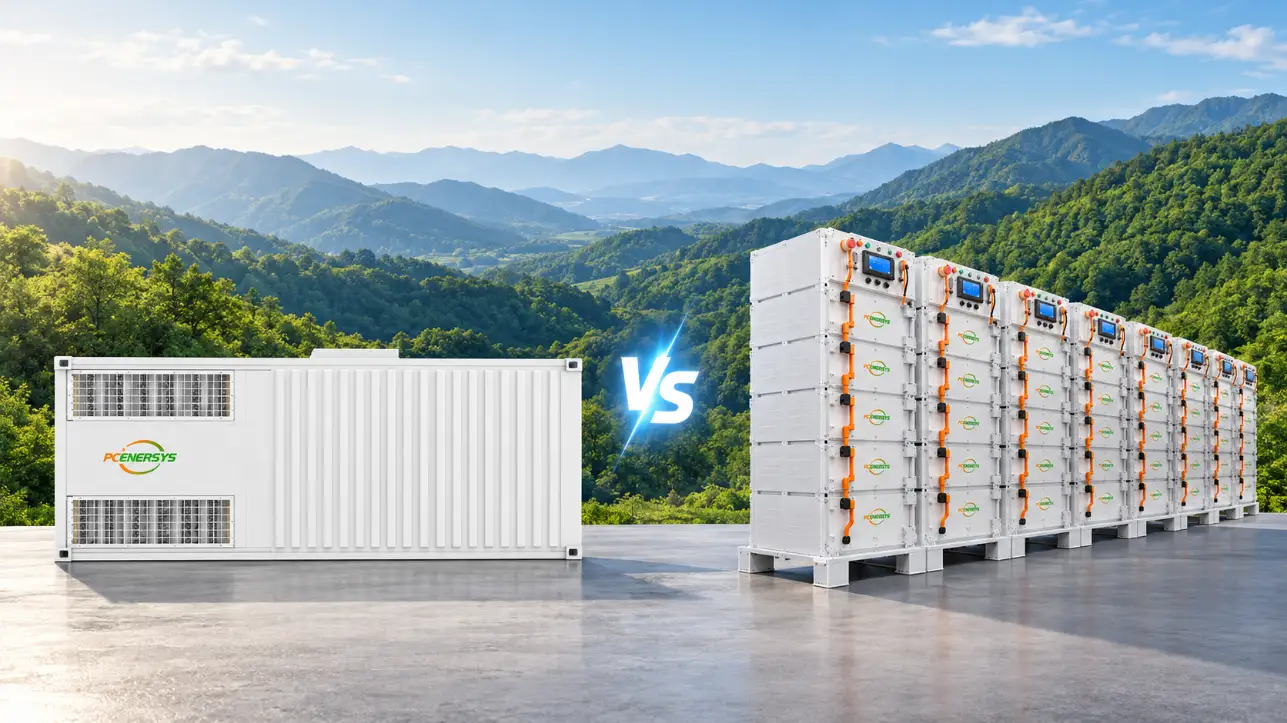
Choosing between a containerized BESS and a cabinet BESS is one of the first decisions in any commercial and industrial (C&I) energy storage project. The containerized vs cabinet BESS question is not about which battery chemistry performs better — both commonly use LFP cells — but about which form factor matches your site, load profile, expansion plan, grid connection and total installed cost.
This guide compares the two formats by capacity, installation, scalability, maintenance and expected returns for C&I owners, energy managers, EPC contractors and system integrators. It provides a neutral, engineering-based view so you can match the right system to the right project and know what to ask a supplier before issuing an RFQ.
Quick Answer: Which One Does Your Project Need?
- Choose a containerized BESS for multi-MWh capacity, an open outdoor site, a one-time build-out and centralized long-duration dispatch.
- Choose a stackable or cabinet BESS for limited space, indoor placement, phased investment, critical-load proximity, or high redundancy and serviceability.
Capacity alone does not decide the choice. Site conditions, expansion schedule, grid voltage, maintenance model and total installed cost together determine the right format. A poor selection usually fails not because the battery is weak, but because site access, lifting, fire safety or phasing rhythm does not match the hardware form factor.
What Are the Two Form Factors?
What Is a Containerized BESS?
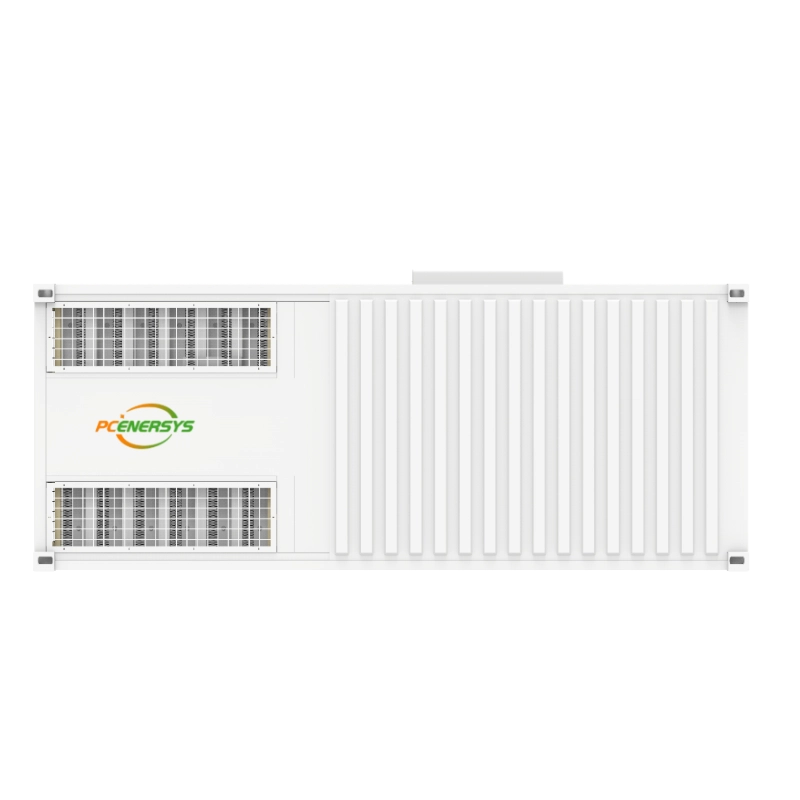
A containerized battery energy storage system integrates battery racks, a power conversion system (PCS), battery management system (BMS), energy management system (EMS), thermal management and fire suppression inside a standard 20ft or 40ft enclosure. Wiring and testing are completed at the factory; the sealed unit is transported whole, placed by crane on site, and connected to the electrical system.
Functionally, it is a centralized "power block" for a dedicated outdoor location. Several parallel containers can form a station of tens of MWh, making the format a natural fit for campus-scale storage, ground-mount solar-plus-storage and utility-scale projects.
What Is a Stackable / Cabinet Energy Storage System?
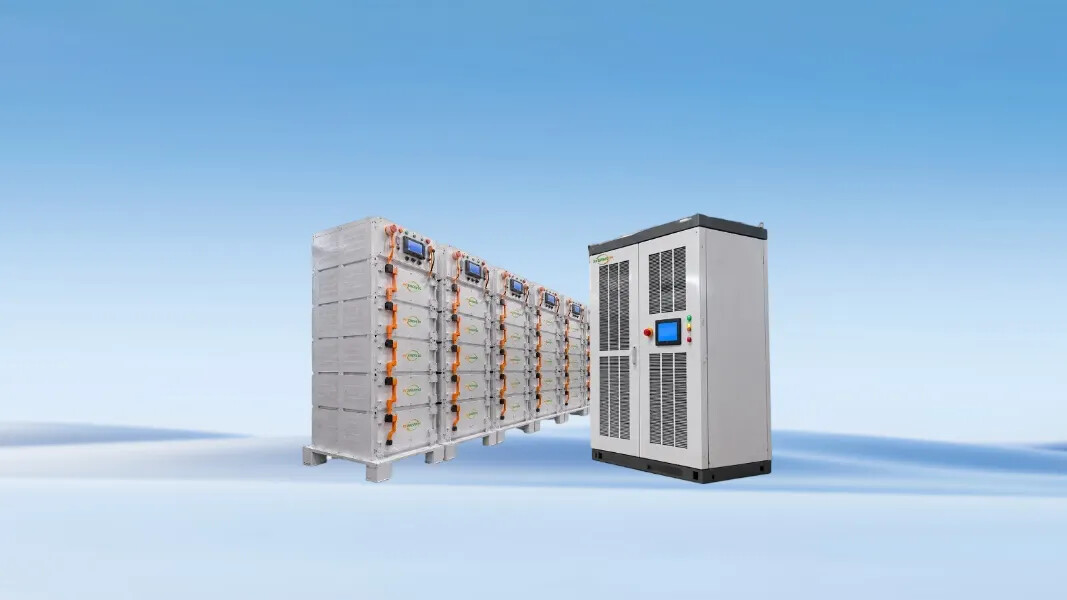
A stackable or cabinet system arranges modular battery modules vertically in cabinets, each with its own local BMS, PCS and safety unit; cabinets connect in parallel on the AC side to grow capacity. The system can go into an equipment room, basement or compact site, move in by forklift, and be installed in stages: deploy what the current load needs, then add cabinets or modules later.
A common misconception: a stackable energy storage system is not limited to small capacity. Modular stacking can reach MWh-scale indoor systems. The defining difference is architectural — distributed, phased and serviceable — not a fixed capacity ceiling.
Containerized vs Cabinet BESS: Side-by-Side Comparison
The table below compares the engineering characteristics of the two formats. Capacity bands are common industry references; actual capacity, power rating and cooling depend on the vendor's specific configuration.
|
Dimension |
Containerized BESS |
Stackable / Cabinet BESS |
|
Typical capacity |
About 1–6+ MWh per unit; multiple units parallel to form tens of MWh stations |
From a single cabinet; modular parallel expansion from hundreds of kWh to MWh-scale indoor systems |
|
Power & grid connection |
Centralized PCS, often paired with a step-up transformer for medium-voltage connection |
Cabinet-level or distributed PCS close to the load; low- or medium-voltage connection per configuration |
|
Installation location |
Dedicated outdoor site |
Indoor equipment room, basement, compact or semi-outdoor space |
|
Site preparation |
Reinforced concrete foundation, fire clearance and crane access required |
Floor loading, ventilation, temperature control and fire separation checks; no large crane required |
|
Thermal management |
Liquid cooling typical for high-density systems |
Air or liquid cooling selected by capacity, density and climate |
|
Scalability |
Added in whole containers; suited to standardized multi-site replication |
Added cabinet or module; finer-grained phased investment |
|
Maintenance availability |
Centralized system; some service may require taking a whole unit offline |
Single cabinet isolated for service while others stay online; better redundancy |
|
Best-fit projects |
Multi-MWh campus storage, ground-mount solar-plus-storage, utility-scale, standardized multi-site rollout |
Land-constrained sites, indoor deployment, phased build-out, backup power and demand management |
In practice, the strongest dividing line is physical access. A containerized system assumes a hardened pad, crane reach and clear fire clearance; a cabinet system assumes a ventilated indoor space with verified floor loading and spare electrical room capacity. Where one set of conditions fails, the other format often becomes the only viable option.
Pros and Cons of Each Format
Containerized BESS: Advantages and Limitations
- At multi-MWh scale, footprint, cabling and commissioning per kWh are lower than distributed alternatives.
- High factory integration; after the pad is ready, on-site connection and commissioning are relatively fast.
- High-density designs commonly use mature liquid cooling with consistent rack-level temperature control.
- Standard containers simplify freight, customs and standardized replication across sites.
- Centralized dispatch suits long-duration storage and grid-side management.
Limitations
- Requires a dedicated outdoor site, reinforced foundation and fire clearance.
- Civil works, crane lifting and heavy transport raise upfront investment.
- A unit fault or core PCS service may take a whole capacity block offline.
- Hard to deploy in access-restricted areas, dense urban cores or sites without crane access.
- Tends toward a one-time build, so initial CAPEX is larger.
Stackable BESS: Advantages and Limitations
- Compact footprint that reuses existing rooms, basements and indoor space.
- Forklift delivery keeps site preparation and road requirements light.
- Phased expansion matches investment to current load, avoiding over-purchase upfront.
- One cabinet can be isolated for service while others run, delivering N+1-style redundancy.
- Proximity to the load shortens cabling; indoor designs also perform well on noise control.
Limitations
- Per-cabinet power and capacity are bounded; very large systems need multiple cabinets in parallel, raising wiring, communication and thermal complexity.
- Indoor deployment must meet floor loading, ventilation, temperature control and fire separation codes, reviewed on site by an engineer.
- Stacking height, structural stability and upper-floor loading require engineering verification.
- At equal large capacity, distributed PCS and BMS configuration usually carries a slightly higher unit equipment cost than a centralized container.
Which Projects Fit Each System?
The selection starts from project type and site conditions, not enclosure preference.
|
Project type |
Preferred format |
Key reason |
|
Manufacturing plant: demand management and TOU arbitrage |
Stackable in compact plants; containerized on open sites with multi-MWh loads |
Load-adjacent redundancy versus centralized bulk dispatch |
|
Office building / commercial property |
Stackable / cabinet |
Sited in an indoor equipment room, providing backup and peak shaving together |
|
Hospital / data center |
Stackable / cabinet (redundancy first) |
Isolated cabinet service without interrupting critical loads; millisecond backup switchover |
|
Hotel / resort in weak-grid regions |
Stackable / cabinet |
Indoor noise control, backup supply and reduced dependence on diesel generators |
|
Retail / supermarket |
Depends on site and capacity |
Protects refrigeration, lighting and critical loads; pairs with solar self-consumption |
|
Campus solar / ground-mount PV / utility-scale |
Containerized |
Multi-MWh capacity, long-duration storage, medium-voltage connection and centralized dispatch |
|
Dense urban core / basement / no crane access |
Stackable / cabinet |
Determined by physical site constraints; stackable is the feasible solution when a container cannot enter |
Browse other residential and C&I deployment cases to see how similar projects were configured.
What Returns Can Each Setup Deliver?
Both formats share the same revenue streams; economics differ by scenario. Actual returns depend on the 12-month load profile, tariff structure, peak-to-valley spread, demand charges, incentives and dispatch strategy, requiring project-level modeling rather than a unit-price judgment.
- TOU arbitrage: charge low-price hours, discharge high-price hours. Container capacity suits long-duration spreads and centralized dispatch; stackable systems suit smaller loads tracking intraday prices flexibly.
- Peak shaving: flatten peaks and cut demand charges. Distributed stackable cabinets sit close to critical loads with per-cabinet redundancy; a centralized container handles whole-plant or campus peaks in one block.
- Backup power: seamless switchover during grid interruption. Stackable systems support millisecond switchover and isolated service; centralized container service must plan for whole-system downtime risk.
- Solar-plus-storage self-consumption: store surplus PV and raise the self-use ratio. Small systems pair with cabinet storage; large ground-mount PV and campus solar match centralized containers.
- Diesel replacement: in weak-grid regions, the EMS coordinates PV, battery, grid and diesel generators; indoor stackable designs are friendlier for noise and aesthetics.
Compare total installed cost, not equipment $/kWh alone: include civil foundations, crane and transport, grid connection, fire separation, phased CAPEX, OPEX, serviceability and redundancy value; levelized cost of storage (LCOS) is the standard comparison basis.
A Five-Step BESS Selection Checklist
- Define load: use 12-month TOU data for peak power (kW), daily shifted energy (kWh) and backup duration.
- Survey the site: indoor or outdoor location, available area, floor loading, crane and road access, fire clearance and ambient limits.
- Clarify expansion: one-time build versus phased rollout; reserve cabinet or container space and spare EMS and electrical capacity for growth.
- Verify grid connection: low- or medium-voltage level, PCS power, approval window and spare switchroom capacity.
- Compare total installed cost and LCOS: put equipment, civil works, crane and transport, grid connection, fire safety, OPEX and redundancy benefits into one model before choosing the format.
Common Selection Mistakes to Avoid
- Choosing the enclosure before the load: no load curve means capacity mismatch.
- Comparing only unit price: ignoring civil works, crane lifting, grid connection, fire safety and commissioning distorts total installed cost.
- Putting a container on a small project: below roughly 1 MWh, logistics, foundation and lifting costs become an outsized share of investment.
- Skipping expansion planning: adding cabinets later only to find electrical, thermal and site headroom exhausted.
- Overlooking access and fire codes: weight limits, crane space or fire clearance shortfalls surface after delivery.
- Running mixed formats without a unified EMS: combined formats need one dispatch strategy; without it, revenue and availability drop.
Matching PCEnerSys Solutions to Both Form Factors
PCEnerSys covers both indoor stackable and containerized routes, matching systems to site and scale rather than forcing one format.
- Indoor stackable: the 6MWh Stackable Indoor Energy Storage System (PC-6MWH-L) integrates 386 LFP modules and three 625kW inverters, rated at 6.1MWh, 1331.1V nominal, 96.5% maximum inverter efficiency and at least 6,000 cycles at 80% DoD and 25°C. The IP21 indoor cabinet supports modular phased expansion; its EMS coordinates PV, battery, grid and diesel generator, switching to backup within milliseconds on grid failure. A deployed project at a hotel in Nigeria covers backup supply and quiet indoor placement in a weak-grid environment. See the 6MWh stackable indoor BESS and the 6MWh indoor stackable BESS launch case.
- Containerized: the 5MWh Liquid-Cooled BESS Container (DC-side, PC-20C-5MWH-L) uses 12 clusters of 418kWh each, a DC range of 1000–1500V, and can pair with a 2.5MW C&I containerized string PCS MV skid. The PCS+EMS+Transformer Dry-type Electrical Container (20C-2500-MV-D_O_Dry) integrates PCS, EMS, step-up transformer and distribution for 10/15/20/35kV high-voltage connection; an independent PCS per string reduces circulating losses caused by centralized parallel connection, improving round-trip efficiency, charge/discharge accuracy and ROI for utility-scale and C&I projects. Explore the 5MWh liquid-cooled BESS container, the 2.5MW MV transformer-integrated storage container, and the full C&I energy storage product lineup.
If the format is still unclear, share site conditions, load profile and target capacity for engineering validation, configuration and a quotation. Contact the PCEnerSys engineering team or send your project requirements for a quote.
FAQ
Q1: What is the difference between a container BESS and a cabinet/stackable BESS?
A container BESS is a factory-prefabricated centralized outdoor power block with large per-unit capacity, concrete pad and crane access for multi-MWh projects. A stackable/cabinet BESS is a modular distributed unit for indoor placement, forklift delivery, staged expansion and cabinet-by-cabinet service, suited to compact sites and high-redundancy applications.
Q2: When should I choose a containerized energy storage system?
Choose a containerized system for multi-MWh centralized storage, open outdoor space and crane access, a one-time build, long-duration dispatch, ground-mount solar-plus-storage or utility-scale application.
Q3: When is a stackable indoor BESS the better choice?
A stackable indoor system is preferable when space is limited, only an equipment room or basement is available, investment should be phased, backup must sit close to critical loads, and one cabinet fault should not take the whole system offline.
Q4: What capacity threshold separates cabinet and container BESS?
A common reference: cabinets below roughly 500 kWh are more economical; containers gain unit-cost advantage above 1 MWh; the 500 kWh–1 MWh range is contested. This is not a hard boundary — the final decision rests on site conditions, expansion plan, grid requirements and total installed cost modeling.
Q5: Does a container BESS need a crane and concrete foundation?
Yes. Containerized deployment normally needs a reinforced concrete foundation meeting loading and drainage requirements, plus crane placement and fire clearance; turning radius, overhead obstructions and ground bearing capacity are verified in the design stage.
Q6: Which system scales better for future expansion?
Staged load growth favors cabinet- or module-level expansion in a stackable system. Containers grow by whole units, which better suits multi-site replication or large projects planned in a single phase.
Related Reading
Solar-plus-Storage Heatwaves Guide: Prevent Thermal Degradation & Protect BESS Lifetime
contact us
For more questions please


Office Address: 701, Building A, Yonghuayuan Business Building, Baotian 2nd Road, Chentian Community, Xixiang Street, Bao'an District, Shenzhen, Guangdong Province, China
Factory Address 1: Room 701, Building 2, Kegu Industrial Park, Zone B, Jian'an Road, No. 790, Chang'an Town, Dongguan City, Guangdong Province, China
Factory Address 2: Building 7, Phase II Standardized Factory, Innovation Industrial Park, Duji Economic Development Zone, Huaibei City, Anhui Province, China