


PCENERSYS BOLG
Why Are Battery Cells Out of Balance? Causes, Symptoms & BMS Fixes
Why Are Battery Cells Out of Balance? Causes, Symptoms & BMS Fixes
Battery cell imbalance occurs when individual cells in a battery pack develop differences in state of charge (SOC), voltage, capacity, or internal resistance. These differences may start small, but can become more pronounced over repeated charge and discharge cycles, reducing usable capacity and triggering premature BMS protection.
But what actually causes battery cells to become imbalanced? And how can you tell whether a voltage difference is a normal variation or a sign of a deeper battery problem?
In this guide, we’ll explain:
- Why battery cells become imbalanced
- How to identify the signs of cell imbalance
- What happens when cell imbalance gets worse
- How BMS cell balancing works
- How to fix and prevent battery cell imbalance
- When cell balancing is not enough to solve the problem
Whether you’re troubleshooting a lithium battery pack or evaluating a battery energy storage system (BESS), understanding cell imbalance is essential for maintaining reliable battery performance and service life.
In large-scale energy storage systems, battery performance degradation is rarely caused by a single catastrophic failure. Instead, it often begins with subtle and gradual changes inside the battery pack, particularly battery cell imbalance. This imbalance manifests as a growing battery voltage difference between individual cells, which can significantly impact system efficiency, usable capacity, and long-term reliability.
While these voltage differences may appear minor in the early stages, their effects compound over time. In systems designed for long-term operation—such as solar energy storage, grid stabilization, or industrial backup power—understanding the root causes of imbalance is essential for both system designers and operators.
For a full system-level explanation, see: battery voltage balance in energy storage systems
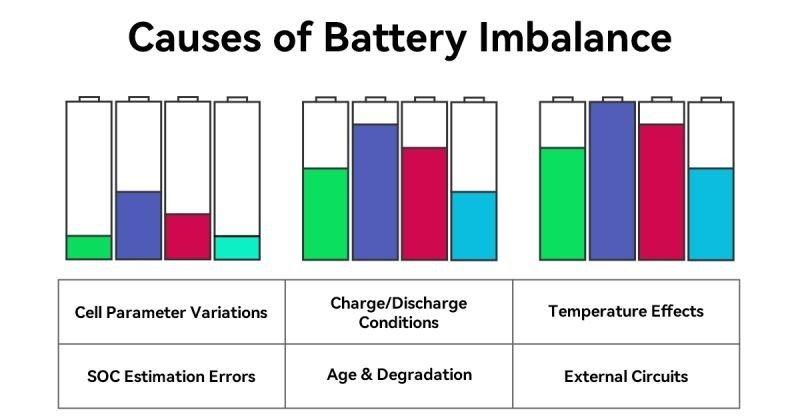
Manufacturing Variations: The Starting Point of Imbalance
Battery cell imbalance begins at the manufacturing stage. Even with advanced production processes, small variations in electrode coating, electrolyte distribution, and internal resistance are unavoidable.
According to the U.S. Department of Energy, these initial differences are one of the primary contributors to long-term voltage divergence in battery systems. Cells that start with slightly different capacities or resistances will respond differently to charging and discharging cycles.
In small battery packs, these variations may not cause noticeable issues. However, in large-scale energy storage systems where hundreds or thousands of cells are connected in series, these small differences accumulate and amplify over time.
Thermal Gradients: A Hidden Driver of Voltage Differences
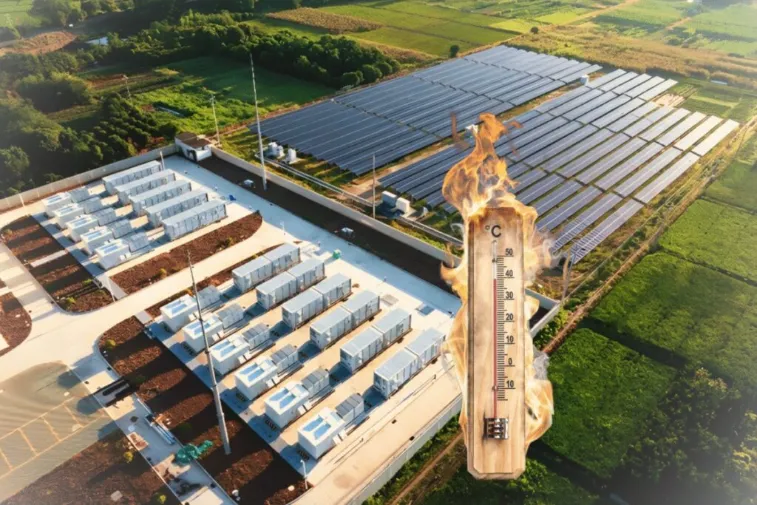
Temperature is one of the most underestimated factors affecting battery consistency. Within a battery pack, temperature distribution is rarely uniform due to environmental conditions, system layout, and cooling design.
Cells operating at higher temperatures tend to experience faster chemical reactions, leading to accelerated degradation. This results in a divergence in both capacity and voltage behavior compared to cooler cells.
The International Energy Agency has highlighted that thermal management is a critical challenge in scaling energy storage systems, particularly in containerized or outdoor installations where environmental conditions vary significantly.
Over time, thermal imbalance translates directly into electrical imbalance, making temperature control a key factor in maintaining voltage consistency.
Uneven Aging and Degradation Patterns
Battery aging is an inevitable process, but it does not occur uniformly across all cells. Differences in local operating conditions—such as current load, temperature, and depth of discharge—cause cells to degrade at different rates.
In practical applications, this means some cells lose capacity faster than others. As capacity decreases, these cells reach their voltage limits earlier during both charging and discharging. This creates a widening gap in voltage levels across the battery pack.
For example, in a solar energy storage system with daily cycling, cells exposed to higher thermal stress may degrade faster, resulting in a measurable battery voltage difference within just a few hundred cycles.
Charging and Discharging Imbalance in Real Systems
Another important factor is how energy flows through the system. In theory, all cells in a series connection should carry the same current. In practice, however, differences in internal resistance and system design can lead to uneven charge distribution.
During charging, some cells may reach full voltage earlier than others, causing overcharging stress if not properly managed. During discharging, weaker cells may reach their lower voltage limit first, forcing the system to stop earlier than expected.
This phenomenon reduces the effective capacity of the entire battery pack and increases the likelihood of long-term degradation.
Real-World Case Study: Capacity Loss in a Commercial Storage System
Consider a 100kWh commercial energy storage system used in a solar + storage installation. Initially, the system operates at full capacity with minimal voltage variation between cells.
After two years of operation, a subset of cells begins to show faster degradation due to localized temperature differences. These cells develop a lower voltage profile compared to the rest of the pack.
As a result, the battery management system limits discharge to protect the weakest cells. The system now delivers only 85–90kWh of usable energy, despite having the same nominal capacity.
This case demonstrates how battery cell imbalance directly translates into economic loss, not just technical inefficiency.
The Role of Battery Management Systems (BMS)
Modern energy storage systems rely heavily on BMS technology to monitor and manage cell-level performance. A well-designed BMS continuously tracks battery voltage, temperature, and current across all cells.
When imbalance is detected, the system can apply corrective actions such as balancing or adjusting operating parameters to minimize further divergence.
However, the effectiveness of a BMS depends on system design, sensor accuracy, and algorithm quality. Simply having a BMS is not enough—its implementation determines how well imbalance is controlled.
Learn how balancing works: battery balancing methods explained
How to Prevent and Minimize Cell Imbalance
Preventing battery cell imbalance requires a combination of design, manufacturing, and operational strategies. High-quality systems begin with carefully matched cells to reduce initial variation.
Thermal management systems are designed to maintain uniform temperature across the battery pack, minimizing differential aging. Operational strategies—such as controlled charge/discharge rates—also play a critical role in reducing stress on individual cells.
Advanced systems further incorporate active balancing technologies, which redistribute energy between cells to maintain voltage consistency over time.
Explore system solutions: advanced battery energy storage system
Conclusion
Battery cell imbalance is a complex issue driven by multiple factors, including manufacturing variation, temperature differences, uneven aging, and operational conditions. While it cannot be completely eliminated, it can be effectively managed through thoughtful system design and advanced monitoring technologies.
Understanding these root causes is essential for building reliable, efficient, and economically viable energy storage systems.
FAQ
What causes battery cell imbalance?
Battery cell imbalance is caused by manufacturing differences, temperature variation, uneven aging, and inconsistent charging/discharging.
How does temperature affect battery voltage?
Higher temperatures accelerate degradation, causing cells to lose capacity and develop voltage differences.
Can battery imbalance be prevented?
It cannot be fully prevented, but it can be minimized through good design, thermal management, and balancing systems.
Why is cell imbalance a problem in energy storage?
It reduces usable capacity, shortens battery lifespan, and increases system risk.
Battery Balancing Methods Explained: Passive vs Active Balancing in Energy Storage Systems
Battery Voltage Balance Explained: Why Cell Consistency Is Critical in Energy Storage Systems

contact us
For more questions please


Office Address: 701, Building A, Yonghuayuan Business Building, Baotian 2nd Road, Chentian Community, Xixiang Street, Bao'an District, Shenzhen, Guangdong Province, China
Factory Address 1: Room 701, Building 2, Kegu Industrial Park, Zone B, Jian'an Road, No. 790, Chang'an Town, Dongguan City, Guangdong Province, China
Factory Address 2: Building 7, Phase II Standardized Factory, Innovation Industrial Park, Duji Economic Development Zone, Huaibei City, Anhui Province, China