


NEWS
ESS Manufacturer | Battery Technology | Global Energy Partner
Slash €260 billion in import costs! The EU builds the "first electricity-powered continent," ushering in a golden era for energy storage and power grids
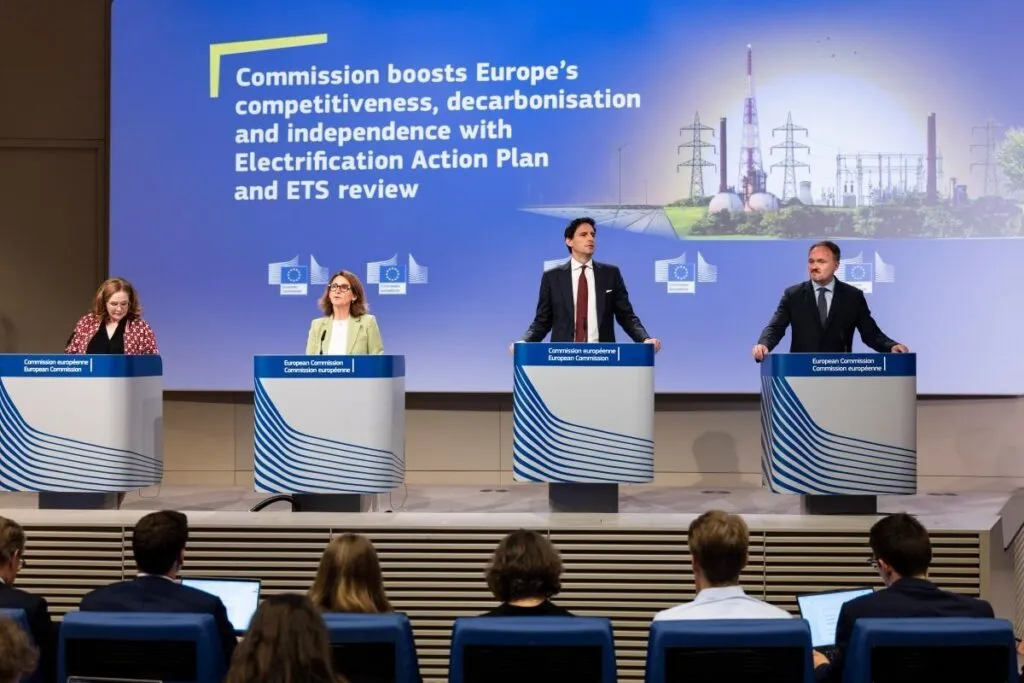
An Inverted-Pyramid Opening and a Policy Breakthrough
July 2026—European Commission President Ursula von der Leyen has officially unveiled a landmark Electrification Action Plan, accompanied by a comprehensive reform package for the EU Emissions Trading System (EU ETS). This suite of major policies aims to fundamentally shift the focus of Europe’s energy mix from a reliance on imported fossil fuels to a localized, clean, and electricity-driven model.
The action plan sets an ambitious core objective: to raise the electrification rate of the EU’s final energy demand from the current 23% to 46% by 2040. This is not merely a climate goal but a strategic economic decision made in response to the energy price volatility and crises Europe has faced in recent years. According to the European Commission’s quantitative assessments, achieving this transition could reduce Europe’s annual fossil fuel import costs by approximately €260 billion. This figure serves not only as a reflection on the more than €1.8 trillion in energy bills the EU incurred due to geopolitical instability over the past few years but also as a key factor in maintaining Europe’s long-term industrial cost advantage.
The reform goes beyond the decarbonization of electricity supply, delving deeply into the efficiency and equity of energy consumption. By linking the EU ETS mechanism with newly established financial support for industrial decarbonization, the EU aims to resolve the "electricity-to-gas price gap" that has long plagued the industrial sector. For Europe, this is no longer just an environmental statement; it is a core strategy to tackle the challenge of high global industrial electricity prices and to boost the global competitiveness of its domestic manufacturing sector. Through this "blueprint for energy independence and industrial renewal," the EU seeks to establish "electrification" as both a core competitive barrier for European industry and a solid foundation for energy independence within the new global competitive landscape.
Analyzing Industry Contradictions: The Critical Bottleneck of "Green Power Surplus" vs. "Lagging Application"
Underpinning Europe's ambitious transition lies a long-dormant yet increasingly acute structural contradiction: the disconnect between explosive growth on the supply side and stagnation on the consumption side. Data shows that Europe has achieved remarkable success in the clean energy transition regarding power generation, with renewable and low-carbon sources now accounting for over 70% of the total electricity mix. However, in key end-use sectors—such as industry, transport, and buildings—the electrification rate remains worryingly stalled at around 23%, a state that has persisted for nearly a decade. This stark contrast—where green power is abundant at the generation stage but underutilized at the application stage—has become a critical bottleneck hindering European industrial decarbonization and economic upgrading.
Industry experts identify three major structural obstacles as the root causes of this "application lag":
First is the severe imbalance in the electricity-to-gas price ratio. In many major European economies, high taxes, grid surcharges, and market design mechanisms mean that retail electricity prices paid by enterprises are consistently more than three times the price of natural gas. This highly distorted cost structure effectively eliminates the economic incentive for industrial firms to switch from gas to electricity.
Second is the worsening issue of grid bottlenecks and grid-connection deadlocks. A flood of speculative grid-connection applications, combined with cumbersome permitting and approval processes, has caused infrastructure expansion to lag significantly behind the pace of the energy transition. Many energy-intensive enterprises and large-scale energy storage projects are forced to wait years to secure a grid connection, resulting in an awkward stalemate: green power is generated but cannot be transmitted, while end-users want to utilize electricity but cannot connect to the grid.
Finally, there is the formidable barrier of high upfront capital expenditure (CAPEX). For traditional industrial enterprises, retrofitting existing gas boilers or blast furnaces with high-capacity industrial electric boilers or electric arc furnaces entails massive equipment replacement costs and underlying production line modification expenses. In the absence of a clear market premium and long-term policy guarantees, enterprises easily find themselves in a financial dilemma: they recognize that decarbonization is the trend but lack the capacity to shoulder the initial investment.
Four Key Solutions: From Tax System Restructuring to €100 Billion in Decarbonization Funding
To address this structural impasse, the European Commission has unveiled a comprehensive policy package within its Electrification Action Plan. Through interventions spanning tax system restructuring, grid upgrades, financial leverage, and end-user incentives, the plan aims to dismantle the deep-seated barriers hindering the electrification process.
Eliminating Price Disparities and Reforming Electricity Taxes
Addressing high electricity costs is the primary focus of the action plan. The European Commission explicitly requires member states to re-evaluate their electricity tax and fee structures, reduce grid tariffs and unnecessary tax burdens on energy-intensive industries, and strictly enforce the principle of fair competition—ensuring that the tax burden on electricity does not exceed that on natural gas. A core quantitative goal is to reduce the electricity-to-gas price ratio to below 2.5:1, thereby fundamentally restoring the cost advantage of electricity in end-use consumption and stimulating the internal drive for businesses to switch to electric energy.
Accelerating Smart Grids and Fast-Tracking Permitting
To tackle severe grid bottlenecks, the action plan urges EU co-legislators to adopt a new grid framework by the end of the year. New regulations will crack down on speculative grid connection applications that merely reserve capacity, while establishing dynamic queuing mechanisms—where unused capacity is relinquished—and fast-track permitting processes. Simultaneously, the plan seeks to maximize the capacity efficiency of existing grid assets and enhance demand-side flexibility through the accelerated deployment of smart meters and digital monitoring technologies.
Linking the Carbon Market (EU ETS) with an "Industrial Decarbonization Bank"
The synergy between fiscal policies and market mechanisms forms the bedrock of the financial support for this reform. The EU proposes fine-tuning the EU Emissions Trading System (EU ETS) by adjusting the linear reduction factor and, starting in 2030, progressively linking the allocation of free carbon allowances to companies' actual decarbonization capital expenditure (CAPEX). Crucially, the EU will leverage resources from the EU ETS Innovation Fund to inject €100 billion into a dedicated Industrial Decarbonisation Bank, providing subsidies and risk guarantees for the "first-of-a-kind" deployment of breakthrough clean technologies in heavy industry.
Lowering Barriers to End-User Technology Adoption
To break the deadlock in upgrading the building and transport sectors, the action plan introduces a series of targeted support policies designed to lower upfront investment barriers. By implementing tax credits, direct purchase subsidies, and "social leasing" models for low-income groups, the plan significantly reduces the initial acquisition costs of heat pumps and electric vehicles, ensuring that end-use electrification is not merely an option for industrial giants but can rapidly permeate broad consumer markets.
Empirical Case Studies: Early Transformations in Heavy Industry and New Energy Supply Chains
To validate the feasibility of the Electrification Action Plan, pioneering practices in European heavy industry and energy infrastructure have provided valuable models for the market.
Industrial Sector: Breakthroughs in Electrification and Decarbonization

In energy-intensive sectors such as steel and chemicals, leading companies are spearheading the redesign of production processes through electrification. A prime example is the HYBRIT project by Swedish steel giant SSAB, which replaces traditional coke-fired blast furnaces with electric arc furnaces (EAF) and utilizes green hydrogen for direct reduced iron (DRI) production. Leveraging funding from the EU ETS Innovation Fund and anticipating capital support from the future Industrial Decarbonisation Bank, such projects have significantly lowered the high capital expenditure (CAPEX) barriers. Similarly, chemical giant BASF has deployed megawatt-scale industrial heat pumps and electric boilers at its major sites to replace existing high-pressure steam gas systems; this demonstrates how heavy industry can simultaneously reduce operating costs and carbon emissions through electrification amidst tightening EU ETS quotas.

Infrastructure Sector: Smart Grids and BESS Response in the Netherlands and Germany
In the Netherlands and Germany—countries with very high renewable energy penetration—grid connection constraints once led to localized grid overloads. To address this challenge, local operators integrated large-scale battery energy storage systems (BESS) with smart charging and swapping networks. By deploying smart meters and demand-side flexibility algorithms, the system can automatically trigger large-scale energy storage or dispatch industrial loads during periods of surplus solar (midday) or wind (nighttime) power—often coinciding with negative electricity prices—and discharge power back to the grid during peak demand. This flexible peak-shaving mechanism not only prevents grid failure but also validates the feasibility of a "storage-enabled consumption and consumption-stabilized grid" model, providing a practical blueprint for the digital upgrade of power grids across Europe.
Industrial Expansion: A Boom Period for BESS, Heat Pumps, and Manufacturing Value Chains
From an industry analyst's perspective, the Electrification Action Plan is not merely an energy policy; it represents a profound reshaping of Europe's supply chains for new energy and heavy industry. As the rate of end-use electrification moves toward the 46% target, the upstream, midstream, and downstream segments of the clean energy value chain are entering a period of structural expansion.
The industry role of Battery Energy Storage Systems (BESS) is undergoing a fundamental shift. Amidst a grid landscape facing doubled power loads, BESS has evolved from an optional, auxiliary feature into essential infrastructure for maintaining power system stability. With new regulations further refining market mechanisms for frequency regulation and energy time-shifting, the commercial revenue models and long-term predictability of energy storage assets will be strongly underpinned by policy frameworks.
In the sectors of industrial heat pumps and fleet electrification, policies explicitly mandate a preference for public procurement and requirements for localized manufacturing ("Made in Europe"). This policy direction will directly drive demand for high-efficiency electric boilers, high-pressure heat pumps, and commercial electric vehicles, compelling the supply chain to accelerate its localization efforts.
Finally, this comprehensive upgrading and expansion of the value chain will generate significant economic spillover effects. The European Commission estimates that the modernization of the entire clean energy supply chain—spanning infrastructure construction, equipment manufacturing, and intelligent operations and maintenance—will create hundreds of thousands of high-quality green jobs across Europe, solidifying the foundation for the domestic revitalization and global competitiveness of European manufacturing.
Conclusion and Strategic Outlook
As European Commission President Ursula von der Leyen summarized at the launch event: "From lowering electricity prices to adapting carbon markets to changing global realities, this is not merely a green transformation; it is a future-oriented investment and a plan for energy independence." The implementation of the *Electrification Action Plan* marks a strategic leap for Europe, shifting from a simple "clean energy substitution" model to one driven by comprehensive electrification.
For industry and investors, the critical period ahead will center on the legislative details of the Energy Union Package—scheduled for rollout in the fourth quarter of 2026—as well as the extent to which individual member states follow through on electricity tax reforms and the streamlining of grid approval processes. As this continent-wide strategic overhaul unfolds, the ability to successfully bridge the "last mile" across fiscal policy, grid infrastructure, and market mechanisms will determine whether Europe can reshape its global industrial competitive advantage on schedule and emerge as the world's first truly "electrified continent."
Australia Renewable Energy FY26: Record 9.1 GW Operations Amid 18-Month Grid Delays
$20 Billion in Investments in Play: Peru Releases Latest National Energy Plan—A Pivotal Turning Point for Energy Storage and Solar PV?
Related Article


contact us
For more questions please


Office Address: 701, Building A, Yonghuayuan Business Building, Baotian 2nd Road, Chentian Community, Xixiang Street, Bao'an District, Shenzhen, Guangdong Province, China
Factory Address 1: Room 701, Building 2, Kegu Industrial Park, Zone B, Jian'an Road, No. 790, Chang'an Town, Dongguan City, Guangdong Province, China
Factory Address 2: Building 7, Phase II Standardized Factory, Innovation Industrial Park, Duji Economic Development Zone, Huaibei City, Anhui Province, China