


PCENERSYS BOLG
U CRA Compliance Guide: How to Choose a Hybrid Inverter for C&I Solar
Introduction and Industry Overview
In the current European energy market, commercial and industrial (C&I) electricity prices are driving many enterprises to actively transition to green energy. To maximize self-consumption rates and mitigate grid fluctuations, integrating hybrid inverters with battery energy storage systems (BESS) during the planning and construction of commercial solar systems has long been the industry-standard configuration. However, as 2026 approaches, this "golden combination" is facing an unprecedented crisis regarding regulatory compliance.
The root cause of this situation lies in the disruptive evolution of inverter technology itself. Inverters were once merely physical hardware responsible for converting direct current (DC) to alternating current (AC); today, however, modern hybrid inverters have evolved into "connected industrial digital gateways" that integrate edge computing, real-time reactive power regulation, over-the-air (OTA) firmware updates, and centralized cloud management. This high level of connectivity and control has inevitably made them new targets for cybersecurity threats.
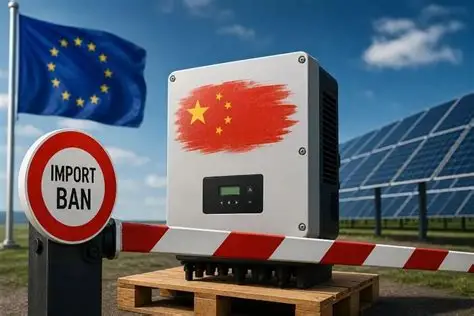
In response, the European Union has adopted a rigorous regulatory stance. The EU Cyber Resilience Act (CRA)—a cornerstone piece of legislation governing cybersecurity access for digital devices—officially entered into force in late 2024. Crucially, the Act’s mandatory requirements for manufacturers regarding vulnerability disclosure and active attack reporting will take effect on September 11, 2026; furthermore, by the end of 2027, any equipment failing to meet CRA cybersecurity standards will face a total ban on sales and market entry.
According to the latest policy impact projections from Wood Mackenzie, the ripple effects of these cybersecurity bans and supply chain decoupling policies are expected to directly reduce European solar PV demand by 14% (approximately 28 GWdc of installed capacity) between 2026 and 2030, while also shrinking battery energy storage deployments by 12%. For project developers and EPC teams, the rules of the game have fundamentally changed. If you want to avoid having your painstakingly developed C&I project ruthlessly rejected at the final grid-connection stage due to equipment cybersecurity compliance issues, then re-evaluating your procurement standards for hybrid inverters has become a critical, make-or-break imperative.
A Plain-English Breakdown of the CRA — Is Your Project Within Range?
When faced with the complex text of the EU Cyber Resilience Act (CRA), commercial and industrial (C&I) project owners and EPC teams often focus on very practical core questions: "Will my project actually be affected? Do I need to replace the equipment immediately?"
To clarify the situation, we first categorize compliance risks into three levels based on the project's "funding nature." This determines the security boundaries your project must adhere to during cybersecurity audits:
Red Alert: Publicly Funded Projects (Very High Risk)
If your commercial solar system relies on the EU Modernisation Fund, the Recovery and Resilience Facility (RRF), or subsidies from member state national budgets, you will face the strictest scrutiny. If the project utilizes hybrid inverter brands from countries designated as "high-risk," public financial institutions will immediately halt fund disbursements.
Yellow Warning: Cross-border and Multilateral Loan Projects (Medium-High Risk)
For cross-border or overseas power plants relying on loans from institutions like the European Investment Bank (EIB) or the European Bank for Reconstruction and Development (EBRD), banks conduct rigorous cybersecurity and bankability compliance audits before releasing funds; non-compliant equipment can directly cause financing agreements to collapse.
Grey Area: Purely Private Capital and Commercial PPA Projects (Low/Medium Risk)
C&I projects funded through commercial Power Purchase Agreements (PPAs) or private capital—while not directly subject to public funding bans—should not be taken lightly. Member states like Germany and Lithuania are already "jumping the gun" by drafting local regulations that mandate physical isolation for grid-connected equipment in critical energy infrastructure; private projects likewise face the risk of surprise inspections under local laws.
So, why does the EU Cyber Resilience Act—a regulation ostensibly targeting digital products—focus so intently on solar-plus-storage power plants?
It comes down to how hybrid inverters are classified under the Act. Within the CRA framework, hybrid inverters are not merely power equipment; they are quintessential "products with digital elements" (PDEs). As it functions as a control node at the network edge and possesses core capabilities—such as remote power limiting, grid frequency regulation, and OTA firmware updates—that could directly threaten the operational safety of the power grid, it is highly likely to be classified as a Class II (critical/high-risk) product. This means that such devices can no longer be connected to the grid based solely on a simple manufacturer's self-declaration of conformity; instead, they must undergo rigorous conformity assessment and cybersecurity vulnerability reviews conducted by an EU-designated Notified Body.
Core Technology Selection Guide: Four Key Dimensions for Choosing a Compliant Hybrid Inverter
Faced with the hyperbolic cybersecurity marketing slogans of inverter manufacturers, procurement managers and engineers for commercial and industrial (C&I) projects must look beyond vague verbal promises when drafting Requests for Proposals (RFPs). To ensure projects remain compliant with the EU Cyber Resilience Act (CRA) regulations for decades to come, a rigorous, technically robust selection mechanism is essential.
When evaluating and selecting hybrid inverters, it is crucial to subject the equipment to a stringent audit across the following four key technical dimensions:
Dimension 1: Essential Credentials—Prioritizing the "Dual Cybersecurity Certification"
For any compliant commercial solar system, the selection of core power conversion and grid-control equipment must meet two "gold standard" industry certifications:
Dual IEC 62443-4-1 and 4-2 Certification: These are cybersecurity standards for industrial automation and control systems. IEC 62443-4-1 verifies that the inverter employs a secure development process throughout its entire security lifecycle—from code writing and vulnerability reviews to post-factory patch maintenance. IEC 62443-4-2 focuses on the technical security specifications of the hardware itself, mandating fundamental security capabilities such as hardware-level authentication, physical tamper protection, and resistance to Denial-of-Service (DoS) attacks.
EN 303 645 Certification: As a baseline specification for Internet of Things (IoT) security, this certification strictly governs the device's underlying cryptographic security. Certified devices must eliminate weak factory-default passwords and utilize secure encryption for personal data storage; furthermore, manufacturers are required to publicly disclose their vulnerability disclosure and patching mechanisms to the EU.
Dimension 2: Data Sovereignty and Encrypted Transmission
Data collected by inverters—including power quality metrics, high-frequency voltage readings, and underlying Battery Management System (BMS) data—is highly sensitive and has been classified as "critical data" by the EU.
Audit of Cloud Server Physical Locations: Ensure that the physical servers hosting the inverter’s associated Energy Management System (EMS) or SCADA platform, data storage nodes, and Over-the-Air (OTA) firmware update servers are deployed within the EU (e.g., AWS Frankfurt or Microsoft Ireland data centers). If data flows back across borders to a non-compliant country, the project will face immediate sanctions, including the denial of grid connection.
End-to-end encryption protocols: Data communication between the inverter's local data logger and the cloud platform must mandate and enable the TLS 1.3 transport layer security protocol, effectively preventing man-in-the-middle attacks at both the physical link and software protocol layers.
Dimension 3: Local autonomy and emergency control capabilities (Islanding & Local Control)
European Transmission System Operators (TSOs) are deeply concerned that external hackers could use malware to tamper with firmware and issue large-scale remote power-limiting commands, potentially causing grid paralysis due to frequency imbalance.
Grid-independent adaptive closed-loop operation: Compliant hybrid inverters must possess robust local autonomous resilience against interference. In the event of external communication loss due to cyberattacks or the physical disconnection of local network cables, the inverter must not lock up, shut down, or output abnormal power. Instead, it must switch to a local offline autonomous mode (Islanding Mode) within milliseconds, maintaining stable power supply based solely on preset local strategies (such as self-consumption, peak shaving/valley filling, and anti-backfeed).
Tamper-proof OTA and physical isolation: Remote firmware updates must utilize multi-factor digital signature verification (MFA) backed by a Hardware Security Module (HSM) to strictly prevent the injection of unauthorized, malicious firmware. Additionally, devices must be equipped with a physical disconnect switch for remote circuit or communication cutoff, allowing O&M personnel to switch the unit to a fully physically isolated mode with a single action during extreme security incidents.
Dimension 4: Software supply chain security and SBOM (Software Bill of Materials)
Supply chain transparency: In accordance with the new market access requirements of the CRA (Cyber Resilience Act), inverter manufacturers must provide a complete Software Bill of Materials (SBOM) to EPC contractors and asset owners. This list must detail every third-party component and open-source code library integrated into the firmware. Through SBOM auditing, project teams can ensure that the hybrid inverter's underlying system does not contain outdated components with publicly known, unpatched vulnerabilities (CVEs), thereby fundamentally eliminating supply chain "backdoor" vulnerabilities.

Navigating EPC Pitfalls: Avoiding the Communication and Accountability Nightmare of "Split Procurement"
Facing the compliance pressures of the EU Cyber Resilience Act, many EPC procurement managers attempt a seemingly clever compromise: "Since importing a complete energy storage system entails compliance risks, why not split the procurement? We could use cost-effective third-party batteries paired with European-brand hybrid inverters that meet EU cybersecurity regulations. This saves money and ensures smooth approval—is it feasible?"
As an engineering team with extensive field experience, our answer is: Stop immediately. This is a recipe for a "communication and liability nightmare."
In the actual construction of commercial solar systems, this "split procurement" approach often leads to three major, fatal technical and commercial complications:
A bottomless pit for communication commissioning: High-frequency, sensitive data—such as individual cell voltage, temperature, and State of Charge (SOC)—collected by the Battery Management System (BMS) requires millisecond-level, real-time interaction with the hybrid inverter, PCS, and SCADA systems. Because the proprietary protocol stacks (Modbus-TCP/CAN) of different brands lack deep factory-level calibration and joint debugging, on-site engineers often spend months rewriting and aligning these stacks. This exorbitant "engineering integration cost" causes severe delays in the project's grid-connection schedule.
Liability disputes and warranty vacuums: A solar-plus-storage system is a highly integrated, interdependent whole. If a serious fault occurs during operation—such as battery thermal runaway or a single-phase ground fault—the lack of a single entity responsible for integration makes it all too easy for inverter and battery manufacturers to shift blame onto one another. This leaves the power plant's warranty status in a prolonged legal limbo, while the project suffers massive economic losses due to downtime.
Uncontrolled Levelized Cost of Energy (LCOE): On the surface, swapping in a compliant European-brand inverter increases the initial hardware investment by only 2% to 8%. However, the labor costs for on-site reconfiguration and custom system integration—combined with the high fees European brands charge for local O&M and extended warranties—significantly drive up the system's LCOE over its entire lifecycle.

Advice on Avoiding Pitfalls:
When planning a commercial solar system, prioritize "All-in-One" solar-plus-storage systems that feature pre-integrated ecosystems and come with comprehensive compliance certifications. If commercial constraints necessitate split procurement, you must—prior to signing contracts—require both suppliers to provide deeply calibrated communication protocol stacks and explicitly define "joint commissioning protocols and liability boundaries" within the contract terms. Never leave system compatibility testing—a task that should be completed by the manufacturer—to be resolved on-site, where costs are significantly higher.
Actionable Tool: The 2026 Commercial Solar-Plus-Storage Compliance Checklist
To ensure your next commercial solar system project is fully secure and seamlessly compliant under the EU Cyber Resilience Act (CRA), we have compiled a highly practical procurement checklist. EPC managers, procurement leads, and project developers can use this table during the RFP (Request for Proposal) stage to audit and select the right hybrid inverter.
Bookmark this page or copy this framework to ensure your hardware choices bypass regulatory hurdles and guarantee bankability:
|
Compliance Evaluation Dimension |
Core Technical Verification Metrics |
Qualified Standard for Approval |
|
Grid Access Credentials |
• IEC 62443-4-1 (Secure Development Lifecycle) • IEC 62443-4-2 (Technical Security Requirements) • EN 303 645 (IoT Security Baseline) |
Must provide formal certificates issued by recognized European third-party testing organizations (e.g., TÜV, DNV, Intertek). |
|
Data Sovereignty |
• Physical location of EMS/SCADA cloud database • Firmware update (OTA) server jurisdiction |
All data interactions, storage, and OTA firmware deployment must physically reside within EU borders (e.g., Frankfurt, Dublin). |
|
Emergency Control |
• Local autonomous control (Islanding Mode) • Physical connection cut-off mechanism |
Inverter must safely operate based on local parameters within 3 seconds of a communication drop-off without grid-collapse risks. |
|
Software Integrity |
• Software Bill of Materials (SBOM) availability • MFA-signed firmware updates |
Vendor must provide a detailed SBOM and verify all OTA patches with hardware-level multi-factor authentication (MFA). |
|
System Integration |
• Standard SunSpec Modbus compatibility • Pre-aligned BMS-PCS protocol stack |
Seamless integration with European EMS/SCADA. Joint commissioning and liability isolation clauses must be locked in multi-vendor contracts. |
|
Financing & Support |
• Bankability Tier Rating • Local O&M and Extended Warranty |
Approved on the white lists of European commercial and development banks. Must offer local, timely field support in EU. |
Conclusion and Call to Action
The impending EU cybersecurity regulatory shift of 2026 is far from a mere drill; it represents a dual trade barrier—spanning both "green" and "technical" domains—that will fundamentally shape the European solar-plus-storage market. With the full implementation of the EU Cyber Resilience Act, cybersecurity has evolved from a niche technical concern into a critical compliance threshold that determines the very viability of power plants. For developers and EPCs, securing high-standard, fully compliant hybrid inverters during the initial planning phase of commercial solar systems is not just about passing grid-connection audits—it is the only way to ensure asset security and bankability throughout the project's entire lifecycle. By grounding your procurement strategy in rigorous cybersecurity standards, you can ensure your project remains resilient amidst shifting policy landscapes.
Has your C&I project encountered critical bottlenecks regarding EU Cyber Resilience Act certification audits? Have you endured the nightmare of protocol integration and liability disputes when attempting to source batteries and hybrid inverters separately? Contact us—our engineers are ready to answer your questions.
Frequently Asked Questions (FAQ)
Q1: Do pre-2026 commercial solar systems need new inverters?
A: No. The EU Cyber Resilience Act is not retroactive. You only need compliant hardware if you perform a major software upgrade or physically replace the hybrid inverter after the deadline.
Q2: Can we bypass CRA compliance by keeping the hybrid inverter offline?
A: Yes, but it ruins your ROI. An offline hybrid inverter cannot perform dynamic peak shaving, remote scheduling, or active battery optimization, stripping the commercial solar system of its financial value.
Q3: Is a supplier's "IEC 62443 aligned" claim enough?
A: No. Self-declarations will fail grid audits. You must demand official IEC 62443-4-1 and IEC 62443-4-2 certificates issued by accredited third-party bodies (like TÜV or DNV).
Q4: How do we protect ourselves in a "split procurement" contract?
A: Enforce three strict clauses before signing:
Pre-aligned Protocols: Mandate pre-tested, compatible Modbus-TCP/CAN stacks.
Joint Commissioning: Bind both vendors to shared on-site debugging hours.
Clear Liability: Explicitly define who pays if a system-wide fault (e.g., thermal runaway) occurs.
Q5: How does "local autonomous control" protect my facility during a cloud hack?
A: The hybrid inverter will immediately disconnect from the compromised cloud and switch to "Islanding Mode" within milliseconds. It continues to run safely using local parameters, keeping your business powered without risking grid instability.
Beyond Textbook GFM: Designing Droop Control That Actually Survives the Field
MW vs. MWh: Why Confusing Power and Energy Destroys BESS ROI

contact us
For more questions please


Office Address: 701, Building A, Yonghuayuan Business Building, Baotian 2nd Road, Chentian Community, Xixiang Street, Bao'an District, Shenzhen, Guangdong Province, China
Factory Address 1: Room 701, Building 2, Kegu Industrial Park, Zone B, Jian'an Road, No. 790, Chang'an Town, Dongguan City, Guangdong Province, China
Factory Address 2: Building 7, Phase II Standardized Factory, Innovation Industrial Park, Duji Economic Development Zone, Huaibei City, Anhui Province, China