


PCENERSYS BOLG
DC Coupled vs AC Coupled BESS in 2026: Stop Comparing Efficiency Numbers — Compare Your Project Type
If you are comparing a DC coupled vs AC coupled battery energy storage system (BESS) for a commercial or industrial project, you have probably seen the same efficiency numbers everywhere: DC coupled reaches 88–92% round-trip efficiency from solar to battery, while AC coupled reaches 82–88%. The marketing message is clear — DC is more efficient, so DC is better.
That message is half the story. The 4–8 percentage-point efficiency gap is real, but it is rarely the deciding factor in whether your project works. What actually decides the choice is the type of project you are building: whether it is a new installation or a retrofit, whether you have solar today or are adding storage later, whether you need backup power, and whether you plan to expand.
This guide is written for C&I owners, energy managers, EPC contractors and design engineers. It explains why the efficiency gap is overrated, where DC coupled hits a hidden ceiling, and how to pick the right architecture for five common project types — plus the five questions every bidder should answer in writing.
Why 2026 Is the Year This Decision Matters
Two shifts are colliding. First, C&I solar-plus-storage has moved from early adopters to mainstream procurement — project sizes now range from 60 kW hybrid cabinets to multi-MWh containerized systems, and the architecture choice is no longer obvious. Second, hybrid inverter technology has matured: 200% PV oversizing, sub-10 ms transfer, and parallel operation up to the low-MW range have narrowed DC coupled's historical cost disadvantage. The result is a market where both architectures are viable, and the wrong choice now costs money not because one is inferior, but because buyers compare the wrong numbers.
Quick Answer: Which Coupling Do You Need in 2026?
The short answer: DC coupled is the best choice for new solar-plus-storage builds designed as one system. AC coupled is the default for retrofits, backup-only, grid-charged peak shaving, and phased expansion.
|
Project type |
Recommended architecture |
One-line reason |
|
New build: solar + storage designed together |
DC coupled |
One design, one grid-connection process, solar charges the battery directly |
|
Retrofit: adding storage to existing solar |
AC coupled |
Do not touch the existing inverter, no downtime, no re-approval |
|
Backup-only (little or no solar) |
AC coupled |
There is no DC side to couple to; a standalone PCS cabinet is the simplest |
|
Peak shaving: battery charges from the grid |
AC coupled |
Charging is already AC→DC; DC coupling adds no efficiency benefit |
|
Phased expansion: more battery or solar in 2–3 years |
AC coupled |
Modular parallel cabinets, no lock-in to one hybrid inverter rating |
If you remember one sentence: DC coupled is optimal for new integrated builds. AC coupled is the safe default for retrofits, expansion, and multi-use projects.
Why the 4–8% Efficiency Gap Is Overrated
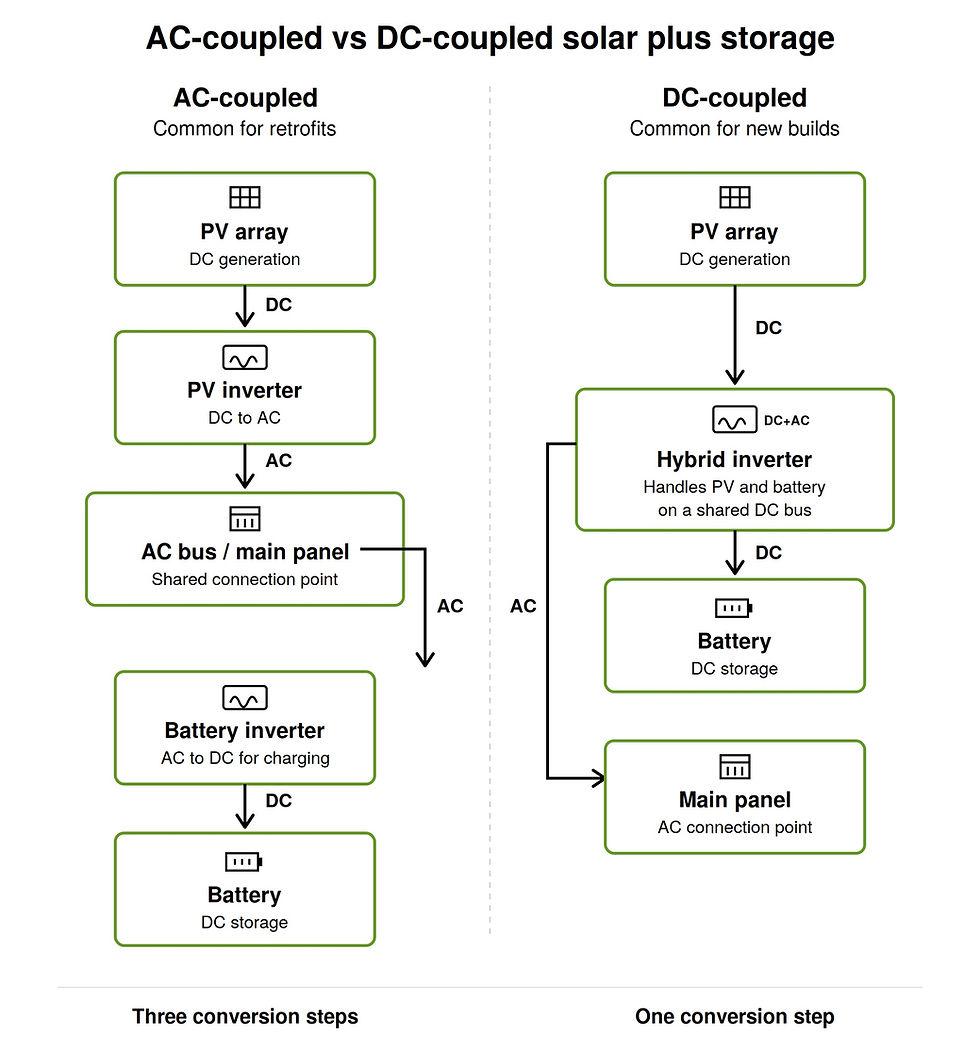
The efficiency number itself is correct. A DC coupled system sends solar DC straight into the battery through one bidirectional hybrid inverter. An AC coupled system sends solar through its own inverter to the AC bus, then a separate battery PCS converts AC back to DC for storage — one extra conversion step. Industry numbers put solar-to-battery round-trip efficiency at roughly 88–92% for DC and 82–88% for AC.
But translate that gap into money on a typical C&I cabinet. Take a 261 kWh system cycling once per day. A 4-point efficiency gap is about 261 × 365 × 4% ≈ 3,800 kWh per year. At a commercial electricity price of roughly \(0.15/kWh, that is about **\)570 per year** — under $6,000 over a ten-year project life.
Now compare that to the cost of getting the architecture wrong. If you force a DC coupled system onto an existing solar installation, you may need to replace the existing inverter, take the site offline during rework, and re-run grid connection approval. Those costs can run into tens of thousands of dollars and months of delay — an order of magnitude larger than the efficiency saving.
The efficiency gap is rounding error on annual revenue. The architecture choice decides whether the project ships at all. Building the decision around 4% efficiency instead of around retrofit cost, downtime, expansion flexibility, and backup requirements is putting the cart before the horse.
The Hidden Limit of DC-Coupled: Your Hybrid Inverter Has a Ceiling
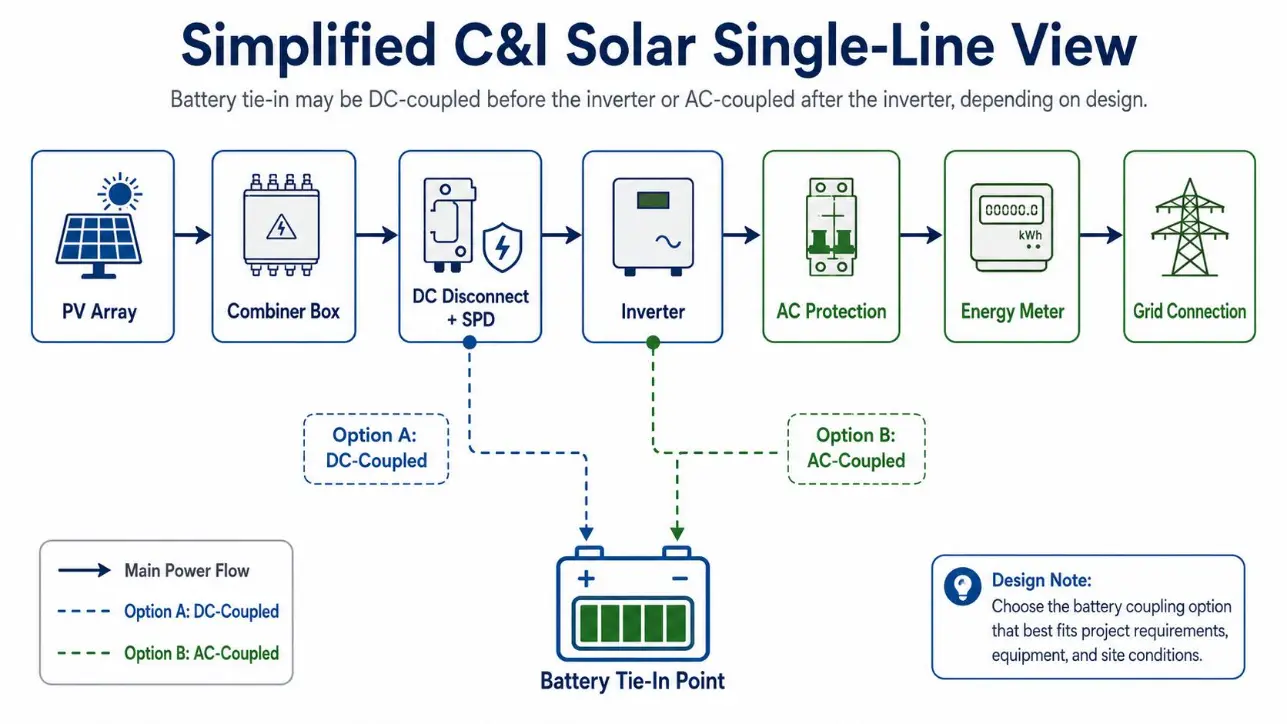
DC coupled's strength — solar and battery sharing one hybrid inverter — is also its hidden constraint. The hybrid inverter has fixed ratings, and three of those ratings become decision points:
Ceiling one: PV oversizing ratio.
Most commercial hybrid inverters accept a PV input of 1.3–2 times their rated AC output. A 125 kW hybrid inverter, for example, typically caps PV input at around 200–250 kW. If your rooftop supports 300 kW of panels, the extra 50 kW gets clipped or wasted under DC coupling — unless you add a separate inverter, at which point you are effectively running AC coupled anyway.
Ceiling two: battery power independence.
In a DC coupled system, the battery discharge power is limited by the same hybrid inverter rating. When the sun is not shining — at night or on cloudy days — the battery cannot discharge more power than the hybrid inverter is rated for. If your backup or peak-shaving duty requires battery power larger than the PV-side configuration, DC coupled cannot deliver it.
Ceiling three: expansion path.
Adding battery capacity later in a DC coupled system usually means upsizing the hybrid inverter or paralleling multiple hybrid units — at which point the cost and complexity converge on an AC coupled architecture. If your investment plan is phased, DC coupled's expansion flexibility is structurally limited.
Engineering note: mainstream C&I hybrid inverters have already pushed PV oversizing to 200% (for example the PCEnerSys HmiWay 125 kW and Solis 75–125 kW models), with sub-10 ms transfer time and parallel operation up to 1.25 MW. That pushes the DC ceiling higher, but it is still a ceiling — not infinite headroom. Before choosing DC, answer three questions: what is my PV oversizing ratio? What independent battery discharge power do I need? Will I expand in the next five years? If the answers push past the inverter rating, AC coupled is the honest answer.
The 2026 Decision Tree: 5 Project Types
The quick-reference table above becomes an executable decision path:
1. New build: solar + storage designed together (rooftop space available, project not yet built)
→ Choose DC coupled. One design, one grid-connection process, solar charges the battery directly. Pick a hybrid inverter with 200% PV oversizing to leave rooftop headroom. Typical fits: supermarkets, office buildings, new factories.
2. Retrofit: adding storage to an existing solar plant already generating
→ Choose AC coupled. A standalone battery cabinet parallels on the AC bus, without touching the existing solar inverter, without downtime, without re-running approval. Typical fits: sites with 2–5 years of operating solar.
3. Backup-only (little or no solar on site)
→ Choose AC coupled. There is no DC side to couple to. A standalone PCS battery cabinet connected to the grid or critical load is the simplest architecture. Typical fits: hospitals, data centers, cold storage.
4. Peak shaving: battery charges from grid off-peak, discharges during demand spikes
→ Choose AC coupled. Charging is already AC→DC; discharge is DC→AC; one conversion step is unavoidable. DC coupling offers no efficiency advantage here. Typical fits: manufacturing plants, workshops with high demand charges.
5. Phased expansion: more battery or solar in 2–3 years
→ Choose AC coupled. Start with one 261 kWh liquid-cooled cabinet and add another cabinet later in parallel, without touching the existing system. DC coupled expansion usually means replacing the hybrid inverter.
 5 Questions to Ask Before Signing Off on a Coupling Choice
Put these five questions into your tender and require a written answer from every bidder:
Question 1: What is my PV oversizing ratio, and what is the hybrid inverter's PV input limit?
If PV capacity exceeds the inverter's PV input limit, DC coupled clips generation — or you end up adding a separate inverter, which is not pure DC anymore.
Question 2: Is battery discharge power independent of the PV configuration?
In a DC coupled system, battery power is capped by the hybrid inverter rating. If you need battery discharge larger than the PV side, AC is required.
Question 3: What is the backup switchover time?
Medical, data center, and cold storage loads typically require sub-10 ms transfer; industrial backup can tolerate seconds. This metric determines whether a hybrid inverter or a standalone PCS cabinet is the right fit.
Question 4: What is the expansion path in year 2 or year 3?
Ask explicitly: does adding battery mean paralleling a standalone cabinet (AC), or upsizing the hybrid inverter (DC)? What is the cost and downtime of each?
Question 5: Is the warranty tied to a single inverter brand?
In a DC coupled system, the battery and hybrid inverter are deeply integrated. If the inverter fails, can the battery still run independently? Is the warranty one-vendor-backed or split across brands?
PCEnerSys' two product lines: We build both DC coupled hybrid inverters — HmiWay 60 kW/125 kW and Solis 75–125 kW with 200% PV input, sub-10 ms transfer, parallel operation up to 1.25 MW — and AC coupled standalone cabinets, including the 261 kWh/125 kW liquid-cooled cabinet and the 5 MWh liquid-cooled container with a 2.5 MW string PCS MV skid. We do not take sides. Send us the five questions above and we will answer in writing.
PCEnerSys' Stance: We Build Both — Pick by Project, Not by Pitch
PCEnerSys delivers both DC coupled hybrid inverters and AC coupled standalone BESS cabinets. Our position is neutral: we do not push DC because we make hybrid inverters, and we do not push AC because we make standalone cabinets.
- DC coupled line: HmiWay 60 kW/125 kW and Solis 3–125 kW hybrid inverters, with 200% PV oversizing, sub-10 ms transfer, and parallel operation up to 1.25 MW — built for new solar-plus-storage integrated builds.
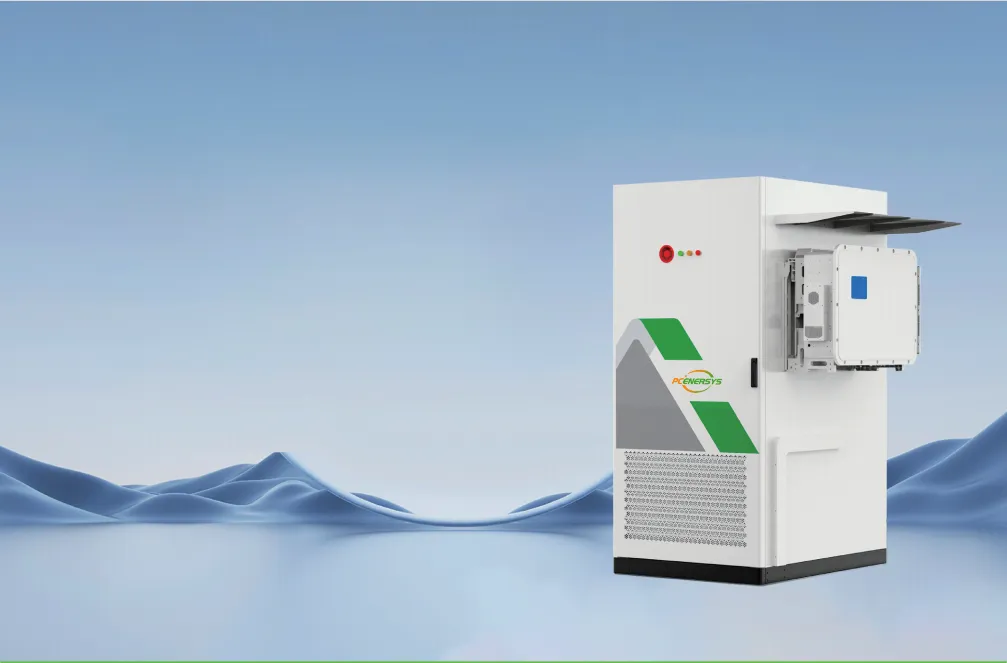
- AC coupled line: 261 kWh/125 kW liquid-cooled cabinet (PC-125TS) and 5 MWh liquid-cooled container (PC-20C-5MWH-L with 2.5 MW string PCS MV skid) — built for retrofits, backup-only, grid-charged peak shaving, and phased expansion.
If your project is at the DC-vs-AC decision point, answer the five questions above first, then look at products. Contact the PCEnerSys engineering team or send your project requirements for a quote, and our engineers will recommend an architecture based on your site, existing solar, load profile, and expansion plan.
FAQ
Q1: Is DC coupled more efficient than AC coupled?
For solar-direct-to-battery charging, DC coupled saves one conversion step and typically reaches 4–8 points higher round-trip efficiency. But for grid-charged storage, independent battery discharge, or retrofit scenarios, that gap disappears or reverses.
Q2: Can I add storage to my existing solar system with DC coupled?
Usually not. DC coupled requires solar and battery to share one hybrid inverter. Existing solar already has its own inverter; forcing DC coupling means replacing it and taking the site offline. This is the classic AC coupled retrofit case.
Q3: What is PV oversizing and why does it matter?
PV oversizing is the ratio of PV array capacity to inverter rated AC power. Mainstream hybrid inverters support 1.3–2× oversizing. Exceeding the inverter's PV input limit clips generation — a hidden cost of DC coupling.
Q4: How long does backup power switchover take?
Hybrid inverters typically switch in under 10 ms, suitable for medical, data center, and cold storage loads. Standalone PCS cabinets switch in seconds, suitable for industrial backup. This metric directly affects the architecture choice.
Q5: Is AC coupled more expensive than DC coupled?
At equal capacity, AC coupled carries a small premium for the separate PCS. But in retrofit scenarios, AC coupled avoids replacing the existing solar inverter and downtime, so lifecycle cost is often lower.
Q6: Can I start with DC coupled and add AC coupled later?
Yes. Many projects start with DC coupled for the initial solar+battery build, then add AC coupled standalone cabinets for expansion. Both architectures can coexist on the same AC bus.
Related Reading
String vs Central PCS: The Availability Number Is Only as Good as Your Maintenance Contract


contact us
For more questions please


Office Address: 701, Building A, Yonghuayuan Business Building, Baotian 2nd Road, Chentian Community, Xixiang Street, Bao'an District, Shenzhen, Guangdong Province, China
Factory Address 1: Room 701, Building 2, Kegu Industrial Park, Zone B, Jian'an Road, No. 790, Chang'an Town, Dongguan City, Guangdong Province, China
Factory Address 2: Building 7, Phase II Standardized Factory, Innovation Industrial Park, Duji Economic Development Zone, Huaibei City, Anhui Province, China