


PCENERSYS BOLG
String vs Central PCS: The Availability Number Is Only as Good as Your Maintenance Contract
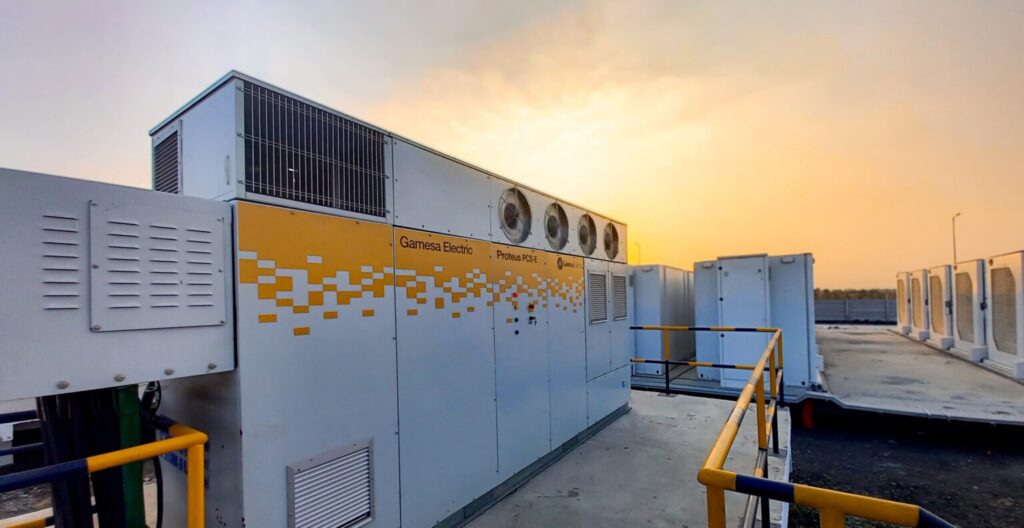 When you compare bids for a battery energy storage system (BESS), the question "string vs central PCS?" usually comes with a confident sales pitch: string converters are more reliable, they isolate faults, and they deliver higher plant availability. The pitch is partially true — but it is only half the equation.
The other half is the maintenance contract. Architecture decides how much capacity you lose in a single fault. Your service contract decides how fast you get it back. Multiply the two, and you get the real annual availability number. If you only negotiate the architecture, you have not negotiated the availability.
This guide is written for C&I owners, energy managers, EPC contractors and O&M managers who are comparing PCS bids in 2026. It explains what string vs central PCS actually means for availability, where the marketing pitch breaks down, and the five questions every owner should ask before signing a contract.
Why 2026 Is the Year the PCS Decision Gets Scrutinized
Two shifts are happening at once. On one side, LFP-based C&I storage has become mainstream, project sizes have climbed from cabinets to multi-MWh containers, and owners are beginning to write availability into their business cases rather than treating it as a vendor afterthought. On the other side, string PCS vendors have aggressively marketed "higher availability" as a reason to pay a premium — and many of those claims are backed by MTBF assumptions that have never been tested under field conditions.
For an owner comparing bids, the risk is not choosing the wrong architecture. The risk is paying a premium for an availability promise that the service contract cannot actually deliver. This guide is built around that distinction.
Quick Answer: When String PCS Actually Wins, and When It's Marketing
The short answer: string PCS wins when two assumptions hold — the smaller converters really have a longer single-unit MTBF, and spare parts are on site and replaced within 24 hours. If either assumption fails, the availability advantage collapses.
- Architecture decides the numerator: one central PCS fault may take 4 MW offline (8% of a 50 MW plant); one string PCS fault takes 0.23 MW offline (0.46%).
- Your service contract decides the denominator: a 24-hour spare-parts response and a 72-hour wait produce a threefold difference in annual capacity loss.
- If string PCS spares take 72 hours to arrive, the "smaller fault" advantage is erased — and the string layout can lose more capacity per year than a central layout repaired in 24 hours.
When you compare bids, do not ask only "are you using string or central PCS?" Ask: "how much MW goes down per fault, where is the spare parts inventory, what is the response time, and what is the penalty clause?"
Why "String Is More Reliable" Is a Half-Truth
The common claim — "string PCS has fewer components, so it is more reliable" — is a half-truth.
Under a parts-count reliability model, with identical components, equal stress and constant failure rates, doubling the number of essential components inside a unit halves that unit's predicted mean time between failures (MTBF). This means:
- A 4 MW central PCS contains more power modules, drive circuits and protection components, so its single-unit failure rate is higher.
- A 230 kW string PCS has fewer components, so its single-unit MTBF is genuinely longer — by vendor claims, roughly twice that of a central unit.
But this is only true at the single-unit level. Across the whole plant:
- A 50 MW plant with 218 string converters experiences about 6.4 faults per year, versus 0.76 faults for a central layout.
- Each string fault removes roughly one seventeenth of the capacity removed by a central fault.
The accurate statement is: string converters are more reliable per unit, but there are more of them, so there are more faults in total — each one smaller. What determines annual capacity loss is the product of fault frequency and fault size, multiplied by repair time.
The Real Math: MTBF × MTTR × Spare Parts × Response Time
Consider an illustrative 50 MW case, built from industry model assumptions (not a single vendor's data):
|
Metric |
String PCS |
Central PCS (24 h repair) |
Central PCS (72 h repair) |
|
Capacity lost per fault |
0.23 MW (0.46%) |
4 MW (8%) |
4 MW (8%) |
|
Expected faults per year |
6.4 |
0.76 |
0.76 |
|
Assumed unit MTBF |
300,000 h |
150,000 h |
150,000 h |
|
Time to restore a unit |
24 h |
24 h |
72 h |
|
Equivalent hours of capacity loss per year |
0.70 h |
1.46 h |
4.37 h |
On the surface, the string layout loses about 52% less annual capacity than the central layout repaired in 24 hours, and 84% less than the central layout repaired in 72 hours. But the result flips when the assumptions change:
Flip one: if string unit MTBF is also 150,000 hours (i.e., you do not assume it is more reliable), annual loss rises to 1.41 hours — essentially the same as the central layout at 1.46 hours.
Flip two: if string spares take 72 hours instead of 24 hours, annual loss rises to 2.11 hours — worse than the central layout repaired in 24 hours.
Both flips teach the same lesson: the string availability advantage depends on two assumptions that you, as the buyer, must verify in writing — that the single-unit MTBF is real and backed by data, and that the spare-parts response time is contractually guaranteed.
The 2026 C&I Decision Matrix: 500 kWh to 10 MWh
For C&I projects (500 kWh–10 MWh), the decision is simpler than at utility scale, because the plant is smaller and single-fault impact is naturally a larger share:
|
Project profile |
Recommended architecture |
Why |
|
500 kWh–2 MWh cabinet (factories, commercial buildings) |
Integrated string PCS cabinet |
Smaller fault impact, self-contained BMS/EMS, simple O&M; see our 6.1MWh indoor stackable system for a modular cabinet example |
|
2–5 MWh liquid-cooled container (campuses, hospitals) |
String PCS (independent per cluster) |
12 clusters controlled independently; one cluster fault does not take down the whole container; modular expansion |
|
5–10 MWh medium project (weak grid, off-grid) |
String PCS + MV skid |
Per-cluster independent PCS eliminates circulating current; direct medium-voltage grid connection reduces conversion stages |
|
High-availability sites (data centers, hospital backup) |
Either architecture, but contract is everything |
Architecture only decides impact; contract decides recovery. High-availability sites must write the SLA into the contract |
|
Extremely space-constrained, efficiency-critical sites |
String PCS |
Eliminates central-parallel circulating current losses, raising system RTE |
|
Weak O&M capability, relying on scheduled vendor visits |
Be cautious with string |
More frequent small faults; without fast response, small faults become long outages |
The matrix above assumes you have already matched the project to a real use case. If you are comparing string PCS cabinets against central containerized solutions rather than two PCS architectures, start from the container-vs-cabinet trade-off before layering the PCS question on top of it. The two decisions interact but should not be conflated.
5 Questions Every Owner Should Ask Before Comparing PCS Bids
This is the most practical section. Put these five questions into your tender document and require a written answer from every bidder:
Question 1: How many MW go down per fault, and what percentage of the plant is that?
Require a PCS topology diagram showing how many battery clusters each converter serves and which clusters are affected during a fault. This is architecture-level and must not be hand-waved.
Question 2: What is the single-unit MTBF, and what is the source of the data?
If a supplier claims "string unit MTBF of 300,000 hours," ask: is this lab data, third-party tested, or a decade of field data? Is there an OEM statistical report available under NDA? An unbacked MTBF number should not enter your decision model.
Question 3: Where is the spare parts inventory, and what is the committed response time?
Ask: is there a same-model spare on site? How many hours from fault to on-site arrival? Is replacement 24 hours or 72 hours? For remote sites, how much transport time is added? This single line determines whether your annual capacity loss is 0.7 hours or 2.1 hours.
Question 4: Which faults are shared single points, and how are they isolated?
String PCS isolates individual converter faults, but it cannot isolate a transformer fault, a common control failure, or a shared protection trip — these can take down multiple converters at once. Ask: which components are shared? Is there redundancy? Can faults be isolated by zone?
Question 5: How is the availability promise written into the contract, and what is the penalty?
A verbal "98% availability" is meaningless. Require: an annual capacity-loss ceiling, penalty clauses for exceeding it, spare-parts delivery time, liquidated damages for response-time overruns. An availability promise without a penalty is marketing copy.
PCEnerSys' approach: availability as a contract, not a slogan. Our dry-type MV container (20C-2500-MV-D_O_Dry) uses independent PCS control for each battery string, eliminating the circulating-current losses inherent in central-parallel configurations. One cluster fault does not affect the others. We do not promise a vague "98% availability" number; we write per-cluster isolation, local spare response and field-replaceable modules into the delivery scope. Our 5MWh liquid-cooled container (PC-20C-5MWH-L), 12 clusters of 418 kWh each, pairs with a 2.5MW string PCS MV skid and is operated cluster by cluster. If your project is in bid comparison, send these five questions to us and we will respond in writing.
PCEnerSys' Engineering Stance: String Architecture + Contracted Availability
PCEnerSys chose the string PCS route not because "string is always better than central," but because in C&I and medium utility scenarios, string architecture plus a contracted service commitment turns the availability advantage into something you can actually bill against:
- Technically: per-cluster independent PCS eliminates central-parallel circulating current and raises system RTE. One cluster fault is isolated; the rest of the container keeps running. Modular expansion lets you phase investment rather than overbuild on day one.
- Commercially: availability is not a slogan. We write spare-parts response time, field-replaceable module process and fault-isolation boundaries into the delivery scope, rather than leaving the owner to absorb O&M risk after handover. If a bidder cannot answer the five questions above in writing, the architecture comparison is secondary.
If your project is in the 500 kWh–10 MWh range and you are comparing PCS architectures, start by sending the five questions above to all bidders and comparing their written answers before scoring technology. The architecture that looks best on a brochure may lose to the one whose service contract actually backs up the availability number. Contact the PCEnerSys engineering team or send your project requirements for a quote, and our engineers will recommend an architecture based on your site, load profile and O&M capability.
FAQ
Q1: Is string PCS really better than central PCS?
In 2026, you cannot say "better" in general. String units have genuinely higher per-unit MTBF, but the plant has more faults in total. Real annual capacity loss depends on MTBF × MTTR × spare-parts response. If the service contract cannot support fast replacement, the string advantage disappears.
Q2: What is a good availability number for BESS?
Industry figures commonly range from 97% to 99%, but a percentage without MTTR, spare-parts and penalty support is meaningless. Ask suppliers for annual equivalent capacity-loss hours, not a headline percentage.
Q3: Does string PCS have higher efficiency?
String PCS eliminates circulating-current losses from central-parallel configurations, so system-level RTE is typically higher than a central-parallel layout. The actual gain depends on topology design; require measured data, not marketing claims.
Q4: How does spare parts inventory affect BESS availability?
Spare-parts inventory and response time directly determine MTTR. The same string PCS layout loses three times more capacity per year with 72-hour replacement than with 24-hour replacement. Remote-site projects must factor in logistics time explicitly.
Q5: Is central PCS obsolete for new projects?
No. Central PCS still has cost and integration advantages in very large utility projects with strong O&M teams and fast local spares. The string advantage is more visible in C&I and medium projects, where single faults are a larger share of total capacity.
Q6: What should be included in a BESS availability contract?
At minimum: an annual acceptable capacity-loss ceiling, spare-parts inventory location and response time, fault-isolation boundaries, liquidated damages for exceeding the ceiling, spare-parts arrival-time overruns, and an annual availability audit clause. Verbal promises do not count.
Sodium-Ion vs LFP in 2026: Buy the Right Chemistry for the Right Job


contact us
For more questions please


Office Address: 701, Building A, Yonghuayuan Business Building, Baotian 2nd Road, Chentian Community, Xixiang Street, Bao'an District, Shenzhen, Guangdong Province, China
Factory Address 1: Room 701, Building 2, Kegu Industrial Park, Zone B, Jian'an Road, No. 790, Chang'an Town, Dongguan City, Guangdong Province, China
Factory Address 2: Building 7, Phase II Standardized Factory, Innovation Industrial Park, Duji Economic Development Zone, Huaibei City, Anhui Province, China