


PCENERSYS BOLG
How AI Is Transforming Battery Energy Storage Profitability: VPP, Algorithmic Trading and ROI Analysis

1. Introduction: The End of the Traditional "Static Arbitrage" Model for Energy Storage
1.1 The Paradox of Renewable Energy Integration
As the global decarbonization process accelerates, the integration of renewable energy sources—such as wind and solar—has experienced explosive growth. However, the inherent intermittency, randomness, and anti-load characteristics of renewable energy have placed unprecedented strain on the physical balance of traditional power systems. In markets such as Australia’s NEM, the US’s CAISO and ERCOT, and various European spot markets, grid congestion and severe supply-demand imbalances—driven by surges in solar generation at midday or wind generation at night—are frequently triggering "negative electricity prices." Under these conditions, generators not only fail to earn revenue but must actually pay the grid to absorb their surplus power.
This environment of highly volatile electricity markets has shattered the profitability assumptions underpinning traditional industrial, commercial, and behind-the-meter energy storage. Historically, Battery Energy Storage Systems (BESS) relied heavily on a simplistic "static peak-shaving" strategy: charging during fixed off-peak periods and discharging during fixed peak periods (typically a "fixed two-charge, two-discharge" daily cycle).
However, the profitability of this static control model is rapidly eroding—or even turning into losses—in modern electricity markets. The core technical and economic reasons for this include:
The "Duck Curve" and the misalignment of peak/off-peak periods: With high levels of renewable energy integration, the timing of peak and off-peak electricity prices is no longer fixed. Static timer-based controls frequently lead to suboptimal outcomes, such as discharging prematurely when prices are still low or depleting the battery's energy before a sharp price spike occurs. For instance, when dealing with the reality of negative electricity prices, static rules are completely incapable of proactively maximizing charging power during negative-price intervals to capture additional subsidies. Lagging Time-of-Use (TOU) Pricing Policies: The pace at which policy-driven TOU rates are adjusted lags far behind the rapid supply-demand fluctuations of real-time electricity spot markets; relying solely on static peak-valley price spreads is no longer sufficient to cover initial capital expenditures (CAPEX) and ongoing operations and maintenance (O&M) costs.
High Opportunity Costs: Static control schemes lock away hardware potential, completely eliminating the possibility for energy storage assets to participate in high-yield ancillary services markets (such as frequency regulation and reserve capacity).
1.2 Entering the New Era of "Smart Energy Storage"
In response to the drastic evolution of market rules and grid configurations, the concept of "Smart Energy Storage" has emerged. A profound paradigm shift is underway regarding the physical attributes and commercial positioning of energy storage assets: they are no longer merely "passive hardware assets" sitting in the corner of a factory's power distribution room, waiting for a timer to issue charge/discharge commands; instead, they have evolved into "algorithmic energy trading nodes" capable of real-time sensing, autonomous reasoning, and millisecond-level responses.
As electricity market liberalization deepens, we must clarify a common industry misconception: the application of AI in energy storage is by no means an ephemeral marketing buzzword, but rather a mathematical solver that identifies optimal solutions within complex, multi-variable, non-linear market dynamics.
As electricity markets transition from "planned dispatch" to dynamic spot trading—with settlement intervals of every 5 or 15 minutes—human operators and basic rule-based logic scripts are completely incapable of handling the real-time calculations required for such multi-dimensional variables. The irreplaceable value of AI algorithms lies in their ability to simultaneously balance three constraints—real-time price arbitrage, grid ancillary services compensation, and battery degradation costs—to calculate the globally optimal charge/discharge trajectory within an extremely short timeframe.
It is precisely this evolution from "passive hardware" to "algorithmic node" that answers the core question—"Can commercial and industrial energy storage actually be profitable?"—and forms the fundamental logic behind the long-term commercial sustainability of modern Smart Energy Storage.
2. Demystifying VPPs: How Aggregator Platforms Consolidate Distributed Energy Resources
2.1 System Architecture of Aggregator Platforms
For an individual commercial or industrial (C&I) owner, deploying a 100kW/215kWh or 1MW/2MWh C&I BESS (Battery Energy Storage System) unit often appears insignificant when facing the vast wholesale electricity market. Independent System Operators (ISOs) and Regional Transmission Organizations (RTOs)—such as ERCOT and CAISO in the US, ENTSO-E in Europe, and PJM—typically impose strict minimum capacity thresholds (often 1MW or even 5MW) for assets participating directly in wholesale market trading. They also mandate costly requirements for dedicated communication lines and dispatch interface certifications.
This scale barrier prevents individual "Behind-the-Meter" (BTM) energy storage assets from directly participating in high-yield electricity trading. This explains the fundamental logic behind how VPP algorithms dispatch distributed batteries for profit: the need to consolidate fragmented assets into a unified whole via an aggregator platform.
A highly scalable cloud-based Virtual Power Plant (VPP) architecture typically comprises three network layers:
Edge Control Layer: Industrial-grade IoT gateways deployed on-site collect real-time data—such as State of Charge (SOC), State of Health (SOH), and instantaneous power headroom—from distributed BESS units, EV chargers, and controllable flexible loads (e.g., high-capacity HVAC systems) using protocols like MQTT or Modbus TCP.
Cloud Aggregation Layer: Utilizing microservices architecture and the OpenADR (Open Automated Demand Response) protocol, this layer abstracts thousands of geographically dispersed Distributed Energy Resources (DERs) into a single virtual power plant with a capacity ranging from tens to hundreds of megawatts.
Market Gateway Layer: This layer connects directly to ISO/RTO APIs to respond to grid dispatch instructions in real-time and submit bid/offer strategies (price and quantity).
2.2 Multiple Revenue Streams: Breaking the Limitations of Single-Source Arbitrage
Through the aggregation capabilities of the VPP Aggregator Platform, distributed energy storage assets unlock "value stacking" potential. This breaks the constraints of relying solely on Time-of-Use (TOU) price arbitrage and establishes a closed-loop business model that integrates multiple revenue streams:
1. Day-Ahead and Intraday Spot Markets
High-frequency algorithms facilitate "buy-low, sell-high" strategies across Day-Ahead Markets (DAM) and Real-Time Markets (RTM). These algorithms monitor Locational Marginal Prices (LMP) in real-time—at 5-minute or 15-minute granularities—and automatically execute charging or discharging when extreme or negative prices occur, thereby capturing value through power market arbitrage.
2. Ancillary Services Market
Compared to spot market arbitrage, ancillary services markets often offer higher returns through capacity compensation and response-based payments:
Primary Frequency Response (PFR): Leveraging millisecond-level response capabilities, energy storage systems provide instantaneous power support whenever grid frequency deviates from the safe baseline (e.g., 50Hz or 60Hz).
Automatic Generation Control (AGC): Energy storage systems receive automated control signals from the ISO to provide precise, minute-level power tracking. Because the response speed and tracking accuracy of Battery Energy Storage Systems (BESS) far exceed those of traditional gas turbines, they can command significant performance premiums in markets like PJM RegD.
3. Demand Response Programs
During summer peak demand or periods of extreme grid load, the VPP platform responds to grid-issued peak-shaving commands. By controlling BESS discharge or curtailing HVAC loads, the system helps prevent regional grid failure. Asset owners earn substantial capacity payments and emergency response incentives as a result.
2.3 Hardware Cornerstone: Grid-Forming BESS
While discussing VPP software-based dispatch, one cannot overlook the evolution of physical hardware characteristics. As the penetration of renewable energy integration surpasses critical thresholds, the rotational inertia traditionally provided by synchronous generators is significantly lost. This results in insufficient system inertia and frequent incidents involving high rates of change of frequency (RoCoF).
This brings us to a core hardware technology issue: the distinction between grid-forming BESS and grid-following inverters in the context of ancillary services.
Grid-Following BESS: These systems rely on the external grid to provide stable voltage and frequency phase references (tracked via Phase-Locked Loops, or PLLs); essentially, they function as "controlled current sources." In scenarios involving weak grids or high penetrations of new energy, PLLs are highly susceptible to losing synchronization, which can trigger cascading disconnections from the grid.
Grid-Forming BESS: These systems employ droop control or virtual synchronous machine (VSM) algorithms to configure the inverter directly as a "controlled voltage source."
In VPP aggregated dispatch, grid-forming BESS serves as a high-value hardware cornerstone. It operates independently of grid voltage signals, autonomously supporting grid frequency and voltage while providing virtual inertia and substantial short-circuit capacity. More importantly, in the event of widespread regional blackouts caused by extreme "black swan" events, grid-forming BESS can provide black-start capabilities; it can independently establish a voltage bus and facilitate the rapid restoration of power to nearby renewable energy sources and loads. This advanced physical support capability makes grid-forming BESS the most highly valued and preferred hardware asset for next-generation VPPs participating in premium grid ancillary service markets.
3. Deconstructing the AI Energy Trading Engine (Core Mathematical and Engineering Logic)

In the era of electricity market liberalization and dynamic spot trading, automated energy trading is not merely a set of hard-coded rule-based scripts; rather, it is a highly sophisticated, closed-loop system comprising three layers: perception, decision-making, and execution. The true value of an AI energy trading engine lies in its ability to transform vast amounts of unstructured data into high-frequency, high-precision market clearing instructions.
3.1 Step One: Multi-dimensional Predictive Analysis (Prediction Layer)
The starting point for trading algorithms is the high-precision forecasting of future electricity market prices and supply-demand conditions. Traditional autoregressive models (such as ARIMA) often suffer from significant lag when dealing with phenomena like price spikes caused by sudden congestion or negative electricity prices in the power market.
Modern AI trading engines employ hybrid time-series forecasting models—based on Transformer architectures (e.g., Temporal Fusion Transformer, or TFT) and Long Short-Term Memory (LSTM) networks—specifically designed to address the critical question of how AI price forecasting improves the return on investment (ROI) for battery storage systems:
High-Granularity Forecasting: Models utilize 5-minute or 15-minute time steps to dynamically forecast Locational Marginal Prices (LMP) over a horizon of 24 to 72 hours.
Multi-Modal Data Fusion: The prediction layer collects and fuses three major categories of heterogeneous data streams in real-time:
Meteorological & Renewable Generation: Numerical Weather Prediction (NWP) data, wind turbine and solar irradiance curves, and real-time curtailment rates.
Grid Topology & Congestion: ISO-published nodal transmission constraints, line maintenance schedules, and regional marginal price components (marginal congestion costs and marginal loss costs).
Load Demand & Historical Clearing: Regional real-time load forecasts and historical clearing price distributions.
3.2 Step 2: Multi-market Co-optimization (Decision-making Layer)
Forecasting electricity prices is merely the first step; the true essence of profitability lies in the co-optimization of BESS arbitrage and frequency regulation services.
The available capacity of a BESS is mutually exclusive within a given time interval: if energy has already been discharged into the wholesale spot market, that capacity cannot simultaneously be reserved to provide "Regulation Up" services for the Automatic Generation Control (AGC) market.
The AI algorithm at the decision-making layer must solve—within milliseconds—either a non-linear mixed-integer programming (MINLP) problem or a continuous control game problem based on deep reinforcement learning (such as PPO or SAC algorithms):
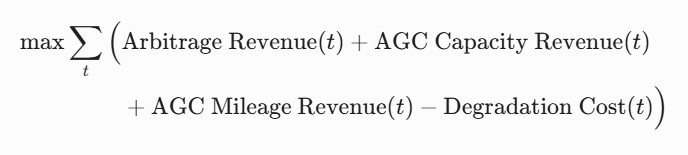
Dynamic Opportunity Cost Evaluation: The algorithm performs real-time, multi-path game-theoretic analysis for the current time interval. For instance, if the spot electricity price is 50/MWh while the AGC Frequency Regulation market offers a high "Mileage Market Premium" of 120/MW due to severe grid frequency fluctuations, the AI model automatically constrains the State of Charge (SOC) to reserve energy for high-yield AGC command tracking.
Boundary Constraints: The optimization process strictly adheres to real-time dynamic SOC range constraints (e.g., 10%–90%), PCS maximum charge/discharge C-rate limits, and real-time State of Health (SOH) degradation boundaries.
3.3 Step 3: Automated Algorithmic Trading (Execution Layer / Trading Bot)
Once the decision layer determines the globally optimal charge/discharge trajectory, the execution layer (Automated Energy Trading Bot) must implement the strategy as actual trades with high reliability and low latency:
Automated Bidding Strategy (Direct ISO API Integration): The algorithmic trading bot automatically generates stepped bid orders containing price-quantity pairs. It connects directly to the API interfaces of power trading hubs—such as ERCOT, CAISO, or PJM in the Americas, or EPEX SPOT in Europe—via secure REST/WebSocket protocols, enabling sub-second strategy submission and order cancellation.
Cloud-to-Edge Command Dispatch: Once a bid clears, the cloud-based trading engine immediately generates high-frequency power control targets. Control commands are dispatched directly through firewalls to the on-site Power Conversion System (PCS) and Energy Management System (EMS) using MQTT (a low-latency IoT protocol) or the highly reliable Modbus TCP/IP industrial communication protocol. Millisecond-level Closed-Loop Safety: Upon receiving charge/discharge power commands from the AI Trading Bot, the edge-based EMS performs safety verification at the underlying hardware logic level (checking individual cell temperature rise, voltage deviation, and SOC limits). It executes a millisecond-level power response only after ensuring safety, thereby completing the full closed-loop process—from market trading signals to the physical flow of electrons.
4. Hidden Costs: The Trade-off Between Battery Health Management and Trading Profits
Driven by high-frequency trading in electricity markets, the pursuit of short-term paper gains can easily lead algorithms to adopt aggressive charge-discharge strategies. However, energy storage assets are not lossless financial derivatives; every throughput of high-power electric current inflicts irreversible electrochemical damage on Lithium Iron Phosphate (LFP) or Nickel Manganese Cobalt (NMC) cells. If the cost of cell degradation is ignored, so-called "high trading returns" merely represent an accelerated erosion of the equipment's capital value.
4.1 Underlying Mechanisms of Physical Battery Degradation
Throughout the lifecycle of a Battery Energy Storage System (BESS), battery degradation is primarily categorized into calendar aging and cyclic aging. Cyclic aging—specifically that induced by automated energy trading—is the primary driver eroding the value of hardware assets:
SEI Layer Growth: At high States of Charge (SOC), active lithium ions in the anode continuously undergo side reactions with the electrolyte, causing the Solid Electrolyte Interphase (SEI) layer to thicken; this depletes the total active lithium and increases the battery's internal resistance.
Lithium Plating: In low-temperature environments or under high C-rates (e.g., rapid charging at 1C to 2C), the rate at which lithium ions intercalate into the graphite anode lags behind the rate of electron migration. This causes metallic lithium to deposit directly onto the anode surface, resulting not only in permanent capacity loss but also creating safety risks—such as separator puncture—that could trigger thermal runaway.
Exponential Impact of Charge-Discharge Depth on Lifespan: This lies at the engineering core of how high Depth of Discharge (DOD) affects BESS battery degradation. There is a non-linear, parabolic relationship between a battery's cycle life and its depth of discharge. Cells subjected to repeated 100% Depth of Discharge (DOD) cycles—such as forced charging from 0% to 100%—experience mechanical stress and lattice fracturing that accelerate degradation at a rate several times higher than that of cells operated within the optimal 20%–80% State of Charge (SOC) range.
4.2 Formula for True Revenue Adjusted for Degradation
A "naive trading algorithm" that focuses solely on capturing peak price spreads in the spot market while remaining "blind" to electrochemical damage is highly likely to fall into a trap where trading activity leads to mounting losses.
To evaluate a project's true economic viability, modern energy operations research employs the "Degradation-Adjusted Net Revenue" formula:
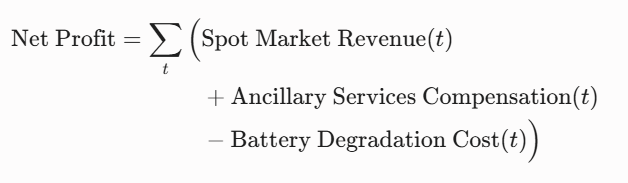
It is crucial to highlight the commercial value of integrating battery degradation costs into energy trading algorithms:
Consider a high-frequency spot market arbitrage trade that generates a nominal market profit of $40 per MWh. However, if the trading command forces a high-power discharge at a 1.5C rate under extreme heat—rapidly dropping the State of Charge (SOC) from 95% to 5% (a 90% Depth of Discharge, or DoD)—the resulting physical depreciation costs (driven by capacity fade, increased internal resistance, and reduced service life) could reach $55 per MWh.
To a simplistic algorithm, this appears to be a successful trade yielding a $40 profit; to the asset owner, however, it represents an erosion of capital resulting in a net loss of $15. Algorithms that fail to account for degradation costs risk prematurely retiring expensive battery assets within a few years, thereby completely wiping out—or even exceeding—the nominal profits accumulated in the spot market.
4.3 AI-based Battery Health Management System (BHMS)
To resolve the zero-sum conflict between trading profits and battery lifespan, next-generation smart energy storage systems are deeply embedding Battery Health Management (BHM) capabilities into the core solvers of their trading decision engines.
Modern AI trading engines enable dynamic control based on State of Health (SOH) sampling by translating electrochemical degradation models into mathematical constraints:
Multi-Objective Optimization: When employing Mixed-Integer Linear Programming (MILP) or Deep Reinforcement Learning (DRL) for multi-market optimization, algorithms incorporate real-time SOC estimation and cell-level internal resistance growth curves as penalty functions within the state space.
Dynamic DoD and C-Rate Caps: The BHMS integrates real-time monitoring data from the Battery Management System (BMS) regarding individual cell status. When localized overheating within a battery module or an increasing voltage differential between cells is detected, the AI trading algorithm adaptively lowers the maximum allowable C-rate for that period and dynamically reduces the Depth of Discharge (DOD) cap from 90% to 70%, forcing the cells to operate within a low-stress, gentle range.
Achieving Global Pareto Optimality between lifespan and revenue: This AI-driven dynamic control extends the battery's physical lifespan by 20% to 40% without sacrificing high-yield market opportunities, ensuring that the energy storage asset achieves a truly maximized lifetime Return on Investment (ROI) over its 10–15 year operational cycle.
5. Real-World Case Study and ROI Economic Analysis
To verify the actual economic benefits of AI trading algorithms and battery health management for energy storage projects, this chapter introduces a model based on a real-world project located in a mature electricity spot market (such as ERCOT/CAISO in the US or NEM in Australia). It presents a quantitative, year-long financial comparison of three different dispatch control strategies.
5.1 Case Background: Australian 10MW/20MWh Front-of-the-Meter (FTM) Standalone Energy Storage Project
Asset Type: Front-of-the-Meter (FTM) standalone/shared energy storage asset
Rated Capacity: 10MW/20MWh (2-hour system, LFP cells)
Market Access: Locational Marginal Price (LMP) real-time spot market + Automatic Generation Control (AGC) frequency regulation ancillary services market
Initial Hardware CAPEX: $7,000,000 (includes complete facilities such as batteries, PCS, BMS, and the step-up substation)
5.2 Comparison of Financial Performance by Strategy
The following table compares the actual financial and physical performance data of three typical dispatch strategies over one year of operation:
|
Financial & Operational Metric |
Strategy A: Static Timer Control (Unmanaged) |
Strategy B: Rule-Based Automation (Fixed Thresholds) |
Strategy C: AI-Driven VPP Co-Optimization |
|
Primary Dispatch Logic |
Fixed 2-charge/2-discharge daily timers |
IF price > $X THEN discharge; IF price < $Y THEN charge |
Predictive ML + Multi-Market MILP Co-Optimization |
|
Annual Spot Arbitrage Revenue |
$620,000 |
$980,000 |
$1,450,000 |
|
Annual Ancillary Services Revenue |
$0 |
$210,000 |
$680,000 |
|
Gross Annual Revenue |
$620,000 |
$1,190,000 |
$2,130,000 |
|
Annual Equivalent Full Cycles (EFC) |
730 cycles |
610 cycles |
520 cycles |
|
Estimated Annual Battery Degradation Cost |
$280,000 |
$210,000 |
$165,000 |
|
Net Realized Annual Profit |
$340,000 |
$980,000 |
$1,965,000 |
|
Project Unlevered IRR (10-Yr Horizon) |
4.2% |
11.5% |
21.8% |
|
Estimated Asset Lifespan |
7.5 Years |
9.8 Years |
13.5 Years |
5.3 Analysis of Key ROI Metrics
A deep dive into the aforementioned financial projections yields clear, quantitative evidence of how AI-driven electricity price forecasting enhances the ROI of battery energy storage systems:
1. Explosive Growth in Internal Rate of Return (IRR) (A jump of +15% to +30%)
The limitations of the traditional static model (Strategy A): Relying solely on timers for peak shaving and valley filling often results in missed opportunities to capitalize on extreme price spikes and completely overlooks the lucrative ancillary services market. After accounting for depreciation caused by excessive battery wear, actual net profits are meager; the project IRR (4.2%) barely covers the cost of capital (WACC).
The breakthrough of the AI-driven model (Strategy C): Powered by an automated energy trading engine, the system achieves real-time co-optimization of spot market arbitrage and AGC frequency regulation. This boosts the project's unlevered lifecycle IRR to 21.8%—an increase of over 17 percentage points compared to the traditional static model.
2. Significant Extension of Asset Lifespan via "Degradation-Aware" Dispatch
Comparative analysis reveals a profound engineering insight: higher returns do not necessarily entail accelerated battery degradation.
The flaw in Strategy B: While rule-based approaches capture some high-price periods, they lack dynamic awareness of Depth of Discharge (DOD) and cell temperature. Frequent high-rate charging and discharging within extreme ranges drives the annual Equivalent Full Cycles (EFC) to 610, with annual depreciation costs eroding nearly 18% of gross revenue.
The advantage of Strategy C: The AI-based battery health management system maximizes revenue while precisely constraining the State of Charge (SOC) operating range and charge/discharge C-rates, thereby avoiding electrochemical operating zones that cause severe degradation. The results demonstrate that Strategy C not only generates nearly 80% higher gross revenue than Strategy B but also reduces the annualized cyclical depreciation cost by 21.4%, successfully extending the physical service life of the energy storage system from 9.8 to 13.5 years.
These concrete figures powerfully prove that the core competitiveness of Smart Energy Storage lies in using AI algorithms to establish a perfect Pareto optimal solution that balances the maximization of market revenue with the minimization of physical degradation.
6. Real-World Engineering Bottlenecks and Industry Pitfalls
While AI-driven automated energy trading presents a compelling business case for energy storage assets, asset owners and software developers face significant technical hurdles during actual engineering implementation and on-site operations and maintenance (O&M). Overlooking these hidden engineering pitfalls can easily result in actual returns and payback periods falling far short of expectations.
6.1 Data Latency and Telemetry Failures
In ideal algorithmic models, data transmission is assumed to be instantaneous; however, in real-world Industrial IoT environments, cloud-to-edge latency and telemetry packet loss are the primary disruptors of trading strategies.
Economic Penalties for AGC Response Latency: In ancillary services markets, frequency regulation commands issued by the ISO via Automatic Generation Control (AGC) typically require energy storage systems to execute millisecond-level power tracking within a 2- to 4-second window. If communication jitter or packet loss lasting five seconds occurs on the 4G/5G or dedicated network connecting the aggregator platform and the on-site Energy Management System (EMS), the system will miss the critical response window.
Compliance Penalties and Revenue Deductions: Such latency not only results in the forfeiture of "mileage payments" for that specific regulation event but also leads the ISO to classify the incident as a "non-compliance event." This can incur heavy financial penalties and potentially result in the suspension of the asset's qualification to participate in premium ancillary services markets.
Pitfall Avoidance Guide: Adopt an Edge AI and cloud-edge hybrid architecture. Shift high-frequency AGC command tracking and sub-second safety protection functions to the on-site edge gateway for direct execution, while the cloud-based aggregation platform issues only minute-level strategic optimization boundaries and electricity price forecast parameters. This enables "autonomous degraded operation" even during network outages.
6.2 Market Volatility & Black Swan Events
Purely data-driven deep learning models (such as LSTMs and Transformers) rely heavily on the quality of historical training data. However, the electricity market is a complex system heavily influenced by physical laws, extreme weather, and geopolitics.
Model Overfitting and Generalization Failure: When encountering extreme "black swan" events—such as a grid-wide blackout caused by extreme cold, a sudden physical disconnection of major transmission lines, or a precipitous drop in photovoltaic output due to severe hailstorms—real-time Locational Marginal Prices (LMP) can instantly skyrocket dozens of times over or plummet into deep negative territory. If an AI model has been trained via overfitting on mild historical data, it is highly prone to generating erroneous operational commands when faced with such unprecedented "distribution shifts."
Massive Losses from Counter-Intuitive Actions: Misjudging trends during price crashes or negative pricing periods—leading to forced high-power discharging—or mistaking price spikes for anomalous noise and opting to shut down and wait, can result in algorithmic errors that wipe out months of accumulated profit in just a few hours.
Mitigation Strategies: Avoid relying solely on "black-box" neural networks; instead, incorporate Physics-Informed Neural Networks (PINNs) and operations research interventions (domain-knowledge constraints). Impose physical grid topology constraints and "safety rule trees" at the neural network's output stage to ensure that, should the algorithm fail during a black swan event, the system can instantly revert to a robust, rule-protected state.
6.3 Protocol Silos & Data Islands
For VPP aggregator platforms, the greatest engineering challenges often lie not in the cloud-based algorithms themselves, but in achieving backward compatibility and connectivity with a diverse array of on-site hardware.
Communication Nightmares with Multi-Vendor BMS and EMS: In actual energy storage power stations, components such as battery modules (OEM BMS), power conversion systems (PCS), electricity meters, and fire safety systems often originate from different vendors. Communication protocols vary widely among manufacturers (e.g., Modbus RTU, Modbus TCP, CANbus, IEC 61850, DNP3, or even proprietary custom protocols).
Telemetry inaccuracy and SOC drift: Some low-end BMS units lack precise dynamic State of Charge (SOC) calibration algorithms, leading to accumulated SOC estimation errors of up to 10%–15% during prolonged operation. If an aggregation platform reads this erroneous SOC data and issues charge/discharge commands, the underlying battery may trigger cell-level overcharge/over-discharge protection and force a trip, thereby disrupting trading operations.
Best practices for avoiding pitfalls: Establish a unified DER (Distributed Energy Resource) Data Abstraction Layer. In addition to standardizing interfaces via open protocols (such as OpenADR 2.0b and IEEE 2030.5), require hardware OEMs to provide access to underlying raw telemetry APIs. Furthermore, deploy edge-based physical algorithms capable of self-learning calibration to perform secondary state estimation and data cleansing on the SOC and SOH data reported by the BMS, thereby eliminating data silos.
7. Conclusion and Outlook: Can AI Really Generate Profit for Energy Storage?
Returning to the central business question of this article: Can AI actually generate profit for energy storage projects? After systematically breaking down power market operating mechanisms, VPP aggregation architectures, algorithmic forecasting and optimization, and the economics of electrochemical degradation, the answer is clear.
7.1 Definitive Conclusion: AI Not Only Generates Profit but Is Essential for Profitability
Undoubtedly, AI can—and already does—significantly boost the commercial returns of energy storage projects (calculations and field data show a step-change increase in net revenue, typically ranging from 15% to 30%).
As the share of renewable energy integration surges globally, power market dynamics—including peak-valley spreads and extreme price spikes—exhibit high-frequency, erratic, and volatile fluctuations. Traditional control methods—relying on manual scheduling, fixed time-of-use (TOU) pricing policies, or simple threshold-based scripts—fail completely when faced with real-time spot markets; in some cases, they even lead to a scenario where operations result in mounting losses.
In modern market-based power trading systems, AI algorithms are not merely optional marketing "icing on the cake." Instead, they represent the only solution—and a fundamental requirement—for transforming smart energy storage assets from low-return or non-recoverable investments into high-return, commercially sustainable ventures.
7.2 Reiteration of Core Logic: Hardware Sets the Floor; AI Sets the Ceiling
The investment and engineering logic for modern energy storage assets can be distilled into a core formula: hardware determines the asset's baseline, while AI determines the revenue ceiling.
The Role of Hardware: Battery cells, power conversion systems (PCS), and fire safety/thermal management hardware are essentially "static hardware assets" within the physical world. High-quality hardware establishes the safety limits, conversion efficiency, and the baseline for usable physical capacity.
The Role of Software and AI: Automated energy trading systems—powered by Virtual Power Plants (VPPs) and deep learning—act as "high-frequency algorithmic traders" residing in the cloud and at the edge. It is precisely this "digital brain" that determines whether this multi-million-dollar hardware asset—over its 10-to-15-year physical lifecycle—will succumb to value erosion through blind depreciation or generate an exceptional lifetime return on investment (ROI) amidst complex, multi-market dynamics.
7.3 Implementation Recommendations: A Practical Guide for Energy Storage Developers and Investors
For developers, Independent Power Producers (IPPs), and institutional investors currently planning or deploying Battery Energy Storage Systems (BESS), the following two core practical guidelines are recommended when evaluating technologies and potential partners:
1. Prioritize Algorithms When Selecting Systems: Focus on Genuine Market-Coordinated Forecasting Capabilities
When selecting Virtual Power Plant (VPP) aggregators or Energy Management System (EMS) vendors, avoid being misled by abstract marketing concepts. Instead, focus on two core technical benchmarks of their software systems:
Forecasting Accuracy: The algorithm’s hit rate—verified through both back-testing and live performance—in predicting Locational Marginal Price (LMP) spikes and negative pricing at 5-minute and 15-minute granularities;
Multi-Market Co-Optimization: The algorithm’s ability to execute millisecond-level dynamic revenue optimization and capacity allocation across spot market arbitrage and Automatic Generation Control (AGC) frequency regulation ancillary service markets.
2. Balance Revenue with Lifespan: Reject "Toxic Deals" That Ignore Battery Degradation
The ultimate criterion for evaluating an algorithm is not whether it can squeeze out the highest paper gross revenue in a single day, but whether it can achieve the perfect Pareto optimal solution—balancing "maximizing market trading revenue" against "mitigating physical battery degradation."
A truly superior AI algorithm must incorporate a sophisticated Battery Health Management (BHM) module capable of real-time monitoring and dynamic constraint management regarding the State of Charge (SOC) operating range and Depth of Discharge (DOD). Only by truly integrating electrochemical depreciation costs into the algorithmic trading logic in a closed-loop manner can we ensure that energy storage assets—while operating safely and robustly—consistently generate genuine net profits for investors over the long term.
Frequently Asked Questions (FAQ)
Q1: Is AI energy trading suitable for Behind-the-Meter (BTM) commercial battery storage?
A: Yes. While individual BTM batteries cannot directly access wholesale markets due to minimum capacity limits, a Virtual Power Plant (VPP) aggregator platform combines multiple BTM assets to participate in high-yield spot arbitrage, demand response, and ancillary services.
Q2: How does AI prevent battery degradation during high-frequency energy trading?
A: Advanced AI algorithms incorporate real-time State of Charge (SOC) and State of Health (SOH) constraints. By evaluating the electrochemical degradation cost per cycle against market revenue, the AI dynamically limits Depth of Discharge (DOD) and C-rates to protect battery lifespan.
Q3: What is the average ROI improvement when using AI algorithmic trading for BESS?
A: Real-world deployments and quantitative models show that AI-driven multi-market co-optimization improves project Net Present Value (NPV) and increases overall Unlevered IRR by 15% to 30% compared to traditional rule-based or static timer dispatching.
Q4: What happens if network latency delays AI cloud commands to the battery site?
A: Hybrid Cloud-Edge architecture mitigates latency risks. High-frequency control (e.g., millisecond-level AGC response and safety checks) is computed locally at the edge gateway, while the cloud platform provides minute-level trading strategies and price predictions.
Balcony Solar with Battery: Smart Investment or Gimmick?
How to Protect Residential Batteries During Extreme Heatwaves? A Comprehensive Guide to Thermal Safety and Overheat Prevention



contact us
For more questions please


Office Address: 701, Building A, Yonghuayuan Business Building, Baotian 2nd Road, Chentian Community, Xixiang Street, Bao'an District, Shenzhen, Guangdong Province, China
Factory Address 1: Room 701, Building 2, Kegu Industrial Park, Zone B, Jian'an Road, No. 790, Chang'an Town, Dongguan City, Guangdong Province, China
Factory Address 2: Building 7, Phase II Standardized Factory, Innovation Industrial Park, Duji Economic Development Zone, Huaibei City, Anhui Province, China